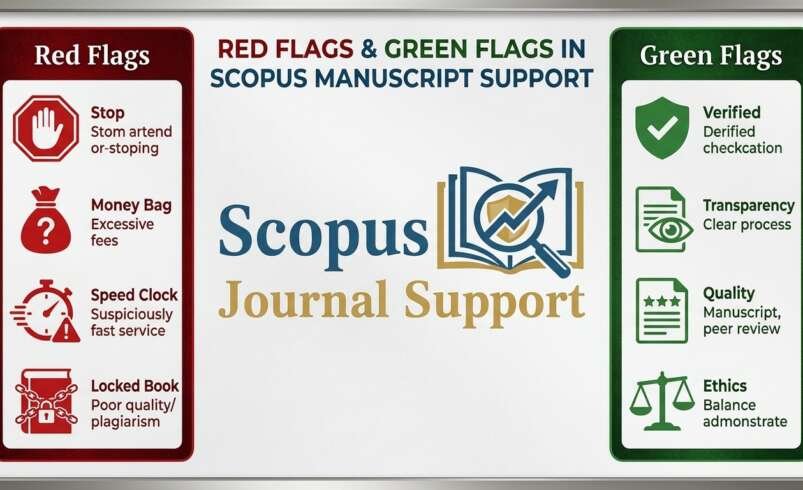

Authors cannot see inside a journal office or a service provider’s workflow, so they judge by signals. Some signals are reassuring, and others should make you stop and check before going further. This guide sorts them into red flags and green flags across three areas: the journal you choose, the manuscript you send and the support you consider. It also shows how high quality Scopus manuscript submission process support Scopus Turkey appears in the green column.
Why Signals Matter More Than Promises
Promises are easy to write and hard to test. A signal is something you can check yourself in a few minutes, such as a title on a source list or a sentence in an author guideline. Treat one red flag as a reason to look closer, not as proof. Treat several together as a reason to walk away. The same applies in reverse, since one green flag proves little and a cluster of them is reassuring.
Journal Red Flags
Start with the journal, because a wrong target wastes more time than any later mistake. Be cautious when you see these signs:
- An unsolicited email that praises a paper of yours and promises a very quick decision
- Indexing logos on the website with no way to confirm them on the official source list
- Aims and scope that cover unrelated fields, as if any paper would fit
- Editorial board names without affiliations, or whose profiles cannot be confirmed elsewhere
- A journal title and ISSN that do not match the source list entry
- Contact details limited to a web form or a personal email address
- Review times that look too short for genuine peer review
None of these alone settles the question. Together they suggest the journal deserves a longer look before you send it anything.
Journal Green Flags
The reassuring signs are the mirror image, and they are just as easy to check.
- Aims and scope that are specific, with recent issues that match them
- A named publisher and a named editorial office with working contact details
- An editorial board whose members can be found on their own institutional pages
- Published policies on peer review, ethics, corrections and retractions
- Detailed author guidelines that explain structure, declarations and file preparation
- A title and ISSN that match the official source list
Indexing status can change over time, so confirm it yourself instead of relying on a colleague’s memory. Authors who look for Scopus indexed journal publication help Turkey are often asking for exactly this independent check, made before weeks of preparation go into a single target.
Manuscript Red Flags and Green Flags
Your own paper sends signals too, and an editor reads them within minutes. It helps to read your draft as a stranger would. Red flags in a manuscript include an abstract that does not state the main finding, a research gap described in vague terms and a methods section that another researcher could not repeat. Reference lists that do not match the in-text citations are another sign of haste, as are sections reused from a thesis without any note to the editor.
Green flags are the opposite. The abstract covers the problem, the method, the finding and why it matters. The limitations are named by the author before a reviewer names them. Declarations on funding, ethics and conflicts of interest are drafted, and a second-choice journal is already ranked. Doctoral students meet these signals most sharply when they turn a thesis chapter into an article. PhD research paper publication help Turkey often comes down to spotting which background belongs only in the thesis and which single question deserves the paper.
Red Flags in a Support Provider
Support is a service you are trusting with unpublished work, so it deserves the same scrutiny as a journal. Be wary of any provider that does the following:
- Promises acceptance, or promises a particular outcome from a review
- Offers to lower a similarity score without changing the substance of the text
- Describes results but never describes the tasks it will perform
- Takes your files without explaining how unpublished data is handled
- Pushes you to decide quickly, or discourages you from asking questions
- Suggests that the provider, and not you, should write the core of the paper
- Submits on your behalf without letting you see the final confirmation
The common thread is a lack of respect for authorship. A manuscript belongs to its authors, and acceptance belongs to editors and reviewers, so anyone who speaks as if the outcome can be bought has misunderstood the process.
Green Flags in a Support Provider
Trustworthy support sounds different. It names tasks, states limits and leaves the author in charge. Scopus Journal Support, for example, works with authors on the stages around the submit button: choosing a suitable journal, preparing the manuscript to that journal’s instructions and keeping communication with the editorial office organised. The ideas, the data and the conclusions remain with the author. That is the working meaning of high quality Scopus manuscript submission process support Scopus Turkey. It means clear steps and honest advice, together with plain language about what nobody can promise.
Before you agree to anything, ask three questions:
- What exactly will you do with my manuscript?
- What remains my responsibility as the author?
- How will my files and unpublished data be handled?
A good answer is specific and a little modest. A suspiciously smooth answer is a red flag in its own right.
Formatting and Editing: Two Places Where Flags Show Up Fast
Formatting is the most mechanical part of the work, and it is also where a second reader adds the most. Scopus journal formatting and submission help Turkey is useful when a journal asks for an anonymised main file, a separate title page, a set citation style and exact figure resolution all at once. A reader who has not seen the file a dozen times will notice the item your own eyes now skip. Editing needs more care. A Scopus plagiarism-free research paper editing service Turkey should make your own wording clearer and point out passages that sit too close to published text. It should never be used to hide borrowed sentences, because the underlying problem stays and the risk stays with the author. A simple test applies to both. If the provider can explain what changed in your file and why, the work is probably sound. If the changes cannot be explained, ask for an explanation before accepting them.
Beyond a Single Article
Some projects sit outside one submission, and a provider should say so plainly. Researchers shaping a monograph should treat book publication as its own path. The proposal, chapter outline, publisher’s review stage and permissions for borrowed figures all need attention, and the timeline is normally longer than for an article.
For most researchers, journal publication remains the main route to being read and cited. It rewards a good match between paper and journal, and a careful reply to reviewers, more than it rewards speed. When a study is still taking shape, research and consultancy services can help sharpen a vague question, test a data plan or give a literature review a workable structure.
At the end of a degree, dissertation writing means keeping one argument steady across many chapters. It goes best when the student leads the thinking and uses guidance for structure and clarity. Scopus Journal Support is glad to discuss which of these fits an author’s position. For researchers working to a tight timetable, affordable manuscript submission support Scopus Turkey should mean support that is accessible and clearly explained, with no confusion about what it covers. In the same spirit, Scopus journal publication support is only worth having when it states what is realistic and what remains the author’s own work.
Questions Scholars Ask When Weighing Their Options
Is a special issue a safer or riskier route?
Neither, by default. Special issues can be well run and focused, but they can also be handled differently from regular issues. Check who the guest editors are, whether the call states the review process clearly and whether the usual editors oversee the final decisions.
Does a journal’s acceptance rate tell me whether to submit?
Rarely. Acceptance rates are calculated in different ways, many journals do not publish them and the figure says little about whether your paper fits. Scope, readership and the quality of recent issues are better guides.
What is a retraction, and can it affect me?
A retraction is a formal notice that a published paper should no longer be relied on, usually because of error, misconduct or a serious problem with the data. If you find one of your own papers is affected, tell the editorial office promptly. Handling it openly protects your record far better than silence.
Can I use AI writing tools while preparing my paper?
Policies differ, and many journals now ask authors to disclose any use of such tools. Read the author guidelines before you begin, keep a note of what you used and for what purpose, and remember that you remain responsible for every claim and citation in the final text.
What should I do if a journal asks me to cite its own articles?
Add a citation only when it is truly relevant to your argument. A request to cite many papers from the journal without a clear scholarly reason is a warning sign. Ask the editor to explain how each suggested reference supports your point, and keep the exchange on record.
Reading the Signals Before You Submit
Most delays begin with a signal that was noticed too late. If you would like a second opinion on a journal, a manuscript or a support offer, the team at Scopus Journal Support is glad to talk it through and explain how high quality Scopus manuscript submission process support Scopus Turkey could fit your plans.