

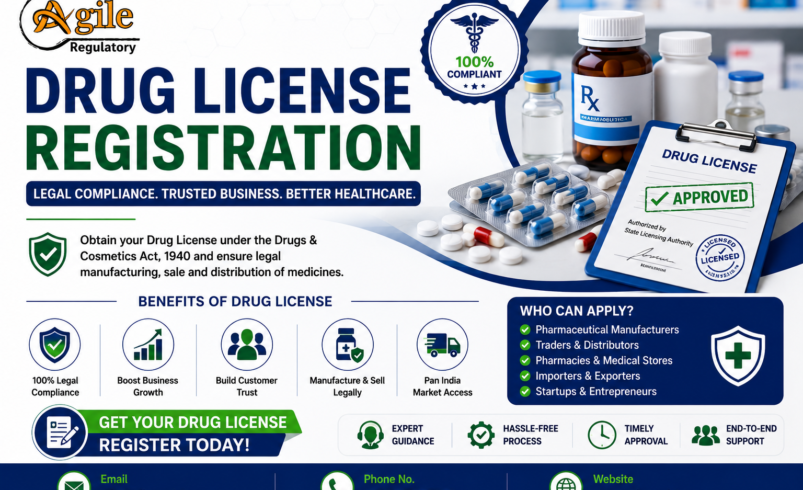

A Food and Drug License is an important regulatory approval for businesses dealing with the sale, storage, and distribution of medicines. Medical stores, pharmacies, chemist shops, hospital pharmacies, and certain healthcare establishments must obtain the appropriate licence before commencing operations. The licence is issued by the respective State Drug Control Authority or Food and Drug Administration (FDA), depending on the state. Understanding the Food and Drug License process helps businesses comply with legal requirements, protect public health, and operate without regulatory issues.
Food and Drug License
What is a Food and Drug License?
A Food and Drug License is a statutory approval issued by the competent State Licensing Authority that permits eligible businesses to sell, stock, distribute, or dispense medicines in accordance with the Drugs and Cosmetics Act, 1940 and the Drugs Rules, 1945.
Obtaining a Food and Drug License is mandatory before opening a pharmacy, chemist shop, hospital pharmacy, or other medicine retail business.
The licence ensures that medicines are stored and supplied according to prescribed quality and safety standards.
Why is a Food and Drug License Important?
The licence provides several significant benefits.
Legal Compliance
It ensures compliance with pharmaceutical laws and state licensing requirements.
Consumer Safety
Licensed businesses maintain proper medicine storage and dispensing practices.
Business Credibility
Customers are more confident when purchasing medicines from licensed establishments.
Business Expansion
The licence enables legal operation and long-term business growth.
Who Should Apply?
The licence is generally required for:
- Medical Stores
- Retail Pharmacies
- Chemist Shops
- Hospital Pharmacies
- Healthcare Clinics
- Pharmacy Chains
- Online Pharmacy Businesses
Applicants should determine the correct licence category before filing the application.
Eligibility Criteria
Applicants generally require:
- Registered business entity
- Commercial premises
- Adequate storage facilities
- Qualified Registered Pharmacist
- Compliance with applicable State Drug Control regulations
Meeting these conditions helps improve approval timelines.
Documents Required
Applicants generally require:
Business Documents
- Business Registration Certificate
- PAN Card
- GST Registration Certificate
- Shop Ownership or Rent Agreement
Professional Documents
- Pharmacist Registration Certificate
- Appointment Letter
- Educational Qualification Certificates
Supporting Documents
- Identity Proof
- Address Proof
- Passport-size Photographs
- Premises Layout Plan
Preparing complete documentation helps reduce processing delays.
Step-by-Step Licensing Process
Step 1 Verify Eligibility
Confirm that the business premises and pharmacist satisfy the prescribed licensing requirements.
Step 2 Prepare Documents
Collect all required business and professional records.
Step 3 Submit the Application
Complete the prescribed application through the designated State Drug Control portal.
Before filing, applicants should ensure that all Medical Store License Requirements relating to premises, infrastructure, and pharmacist qualifications have been fulfilled.
Step 4 Inspection
The licensing authority may inspect the premises to verify compliance.
Step 5 Licence Approval
After successful verification, the licence is issued by the competent authority.
Medical Store Renewal
Businesses should monitor the validity of their licence throughout their operations.
Timely Medical Store Renewal helps avoid interruptions in business activities and ensures continued compliance with applicable pharmaceutical regulations.
Operating Without a Licence
Selling medicines without proper approval may lead to regulatory action.
Running a Medical Store Without License may attract penalties, suspension of business activities, or prosecution under applicable laws.
Businesses should obtain approval before commencing operations.
Retail Pharmacy Licence
Retail medicine businesses require the appropriate licence category.
A valid Medicine Retail Licence authorizes eligible businesses to dispense medicines directly to consumers while complying with prescribed legal standards.
Applicants should obtain the licence before beginning retail sales.
Medical Shop Licence
Different states may use different terminology for the same approval.
Many businesses refer to the required approval as a Medicine Shop Licence, particularly for retail pharmacies and chemist shops.
The licensing requirements remain subject to the applicable state regulations.
Pharmacy Licence
Businesses engaged in medicine retailing commonly use another similar term.
A Medicine Shop License allows eligible establishments to legally stock and sell medicines under the supervision of a qualified pharmacist.
Proper infrastructure and documentation remain mandatory.
Online Pharmacy Licensing
The pharmaceutical sector has increasingly adopted digital services.
Businesses planning internet-based medicine sales should obtain an Online Medical Store Licence wherever applicable under the prevailing regulatory framework.
Applicants should verify the latest licensing requirements before launching online operations.
Digital Licensing Process
Many State Drug Control Departments now provide online application facilities.
Eligible applicants may obtain an Online Medical Store License by submitting applications through the designated government portal, subject to the procedures applicable in their respective state.
Benefits of a Food and Drug License
Obtaining the licence offers several long-term advantages.
Regulatory Compliance
Businesses comply with pharmaceutical regulations.
Better Customer Confidence
Licensed establishments earn greater public trust.
Legal Business Operations
The licence enables lawful sale and distribution of medicines.
Sustainable Business Growth
Compliance supports long-term expansion and regulatory stability.
Common Mistakes to Avoid
Incomplete Documentation
Missing records frequently delay approval.
Incorrect Business Information
Ensure that application details match official documents.
Non-Compliant Premises
Maintain prescribed storage and infrastructure standards.
Delayed Renewal
Renew the licence before expiry to avoid interruptions.
Why Choose Agile Regulatory?
Agile Regulatory provides professional consultancy for pharmaceutical licensing across India. Our experienced compliance professionals assist pharmacies, hospitals, wholesalers, healthcare businesses, and medical stores with documentation, application filing, regulatory coordination, and complete licensing support.
Apart from pharmaceutical licensing, Agile Regulatory also offers consultancy for:
- CDSCO Registration
- Medical Device Registration
- FSSAI License
Our experts ensure accurate documentation and hassle-free approvals, enabling businesses to remain fully compliant with regulatory requirements.
Conclusion
Obtaining a Food and Drug License is an essential legal requirement for businesses engaged in the sale or distribution of medicines in India. The licence ensures compliance with pharmaceutical laws, protects consumer safety, and strengthens business credibility. By preparing complete documentation and following the prescribed licensing procedure, applicants can avoid unnecessary delays and operate confidently within the legal framework. With expert guidance from Agile Regulatory, businesses can complete the licensing process efficiently and focus on delivering quality healthcare products to their customers.
FAQs
1. What is a Food and Drug License?
A Food and Drug License is a statutory approval that allows eligible businesses to sell, stock, distribute, or dispense medicines in accordance with applicable pharmaceutical regulations.
2. Who requires a Food and Drug License?
Medical stores, retail pharmacies, hospital pharmacies, healthcare establishments, pharmacy chains, and online medicine businesses generally require this licence.
3. Is a registered pharmacist mandatory?
Yes. A qualified registered pharmacist is generally required for obtaining a retail medicine licence.
4. What documents are generally required?
Applicants usually require business registration documents, pharmacist qualification certificates, premises proof, GST registration, identity proof, and supporting business records.
5. How can Agile Regulatory help?
Agile Regulatory provides complete assistance with Food and Drug License applications, documentation, online filing, renewal support, regulatory compliance, and end-to-end licensing services across India.