
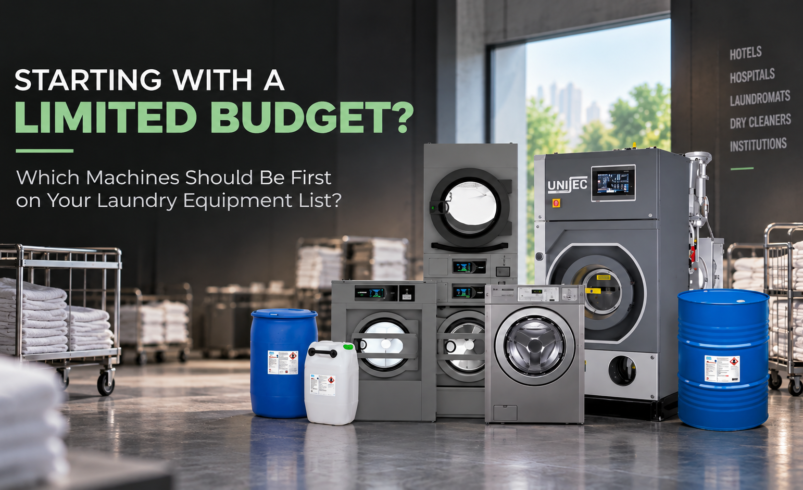

Starting a commercial laundry does not mean you need to buy every machine on day one. When the budget is limited, the smarter approach is to build your laundry equipment list around the services you plan to offer, expected daily laundry volume, available space, and customer requirements.
The goal is to invest first in equipment that directly supports your core operations, then add specialized or higher-capacity machines as your customer base and processing volume grow.
What Should Be First on a Commercial Laundry Equipment List?
Before comparing machines and prices, decide what your laundry will actually process.
A laundry serving hotels may handle large quantities of bedsheets, towels and other linen. A laundry working with restaurants may process table linen, kitchen linen and uniforms. A wash-dry-fold business may have a completely different load mix.
That means there is no single commercial laundry equipment list that works for every startup.
Start by answering four questions:
-
Who are your target customers?
-
What textiles or garments will you process?
-
How many KG do you expect to process each day?
-
Which services will you provide in-house?
Once these are clear, your laundry business equipment list becomes easier to prioritize.
For a basic wash-and-dry operation, the core equipment will generally revolve around washing and drying. Depending on your service model, you may also need finishing, sorting, chemical handling, trolleys, packing stations, and other supporting equipment.
Instead of thinking, “Which machines can I afford?”, start with:
Customer Type → Service → Daily KG → Required Process → Equipment
This prevents you from spending a limited budget on equipment that may not be necessary during the early stage of the business.
Washer, Dryer or Finishing Equipment—Which Machines Should You Prioritize?
When building a laundry equipment list, washing equipment is usually one of the first major decisions because almost every standard laundry workflow begins there.
A commercial washing machine or commercial washer extractor should be selected according to practical load requirements rather than simply buying the largest capacity within your budget.
But washing capacity alone does not create a complete operation.
Commercial Washer Extractor
The washer extractor handles the washing process and removes a portion of the moisture during extraction. Capacity should match the types of loads you expect to process and your required daily throughput.
Commercial Tumble Dryer
If the textiles you process require tumble drying, your commercial tumble dryer needs enough practical capacity to support the washing section.
If washing finishes faster than drying, wet loads begin waiting, and the dryer becomes the bottleneck.
Laundry Finishing Equipment
Your need for laundry finishing equipment depends heavily on your customers.
For example, a business processing hotel bed linen may place greater importance on flatwork finishing than a basic wash-dry-fold operation. Uniforms and garments can require a different finishing process.
The right priority is therefore not always:
Washer → Dryer → Finishing
It should be:
Customer Requirement → Processing Workflow → Essential Machines
This keeps the initial laundry business investment focused on equipment that can actually generate revenue.
Which Laundry Equipment Can You Buy Later as Orders Increase?
A limited budget does not necessarily mean compromising the complete business plan. It may simply mean dividing the plan into phases.
Rather than buying every type of industrial laundry equipment immediately, identify what is essential for launch and what can be added when demand justifies it.
|
Start With |
Add As You Grow |
|
Core washing capacity |
Additional washer capacity |
|
Required drying capacity |
Additional or larger dryers |
|
Essential handling equipment |
More material-handling equipment |
|
Basic sorting and packing setup |
Expanded sorting/packing stations |
|
Finishing required by initial customers |
Specialized finishing equipment |
|
Essential chemical handling |
More advanced dosing arrangements where suitable |
The exact division will vary by business.
For example, if your initial customers mainly need washing and drying, investing heavily in specialized finishing equipment before securing customers who require it may tie up capital unnecessarily.
On the other hand, if your first major contract involves hotel linen with defined finishing requirements, that equipment may need to be part of the initial commercial laundry setup.
Think of your equipment plan in three stages:
Launch → Stabilize → Expand
Your first-stage machines should support confirmed or realistically expected business. Expansion equipment can then be added when customer volume, service mix or processing pressure creates a genuine need.
How Do You Match Your Laundry Equipment List to Daily KG and Customer Type?
Machine capacity should be calculated from the laundry you expect to process rather than chosen only from the laundry machine price.
Start by estimating daily volume.
Then calculate:
Required Daily Loads = Expected Daily KG ÷ Practical Average Load
For example, suppose a startup expects 180 KG of laundry per day and its practical average load is 18 KG:
180 ÷ 18 = 10 loads per day
This is only a planning example, not a recommended machine capacity. Actual requirements depend on textile categories, machine specifications, loading practices, wash programs, operating hours and peak demand.
Next, break the volume down by customer type.
Imagine your business receives linen and garments from:
-
Hotels
-
Restaurants
-
Gyms
-
Spas and salons
-
Commercial establishments
Not every kilogram should automatically be treated as one identical load. Different textiles may require separate sorting, programs, drying methods and finishing.
Once the practical loads are understood, evaluate the entire processing chain:
Daily KG → Sorting → Practical Loads → Washing → Drying → Finishing → Packing
Your washer may be capable of processing the required volume, but if drying or finishing cannot keep up, buying more washing capacity alone will not solve the problem.
A good laundry equipment for a business plan therefore focuses on balanced throughput rather than the capacity of one machine.
How Should You Divide a Limited Laundry Equipment Budget?
When entrepreneurs compare laundry equipment prices, it is easy to allocate most of the budget to the machines themselves.
But the purchase price is only one part of setting up the operation.
A more useful planning formula is
Equipment Budget = Core Machines + Installation + Utilities + Supporting Equipment + Initial Operating Requirements
Depending on your site and selected machines, the overall budget may need to be considered:
-
Washer and dryer purchase
-
Required finishing equipment
-
Installation
-
Electrical requirements
-
Water supply and drainage
-
Ventilation or heating requirements
-
Site preparation
-
Trolleys and material handling
-
Sorting and packing areas
-
Initial operating requirements
For this reason, a low laundry equipment cost does not automatically mean a low total setup cost.
A machine may appear affordable but require site changes or utility arrangements that affect the final investment. Another machine may fit the existing infrastructure more easily.
When working with a limited budget, divide spending based on operational priority:
Essential for Opening → Essential for Current Customers → Needed for Growth
This approach also leaves room for working capital instead of putting the entire startup budget into equipment before the business begins operating.
How Orgaearth Can Help
Choosing laundry machines for business becomes easier when equipment selection starts with expected volume, customer type, available space, and utilities.
Orgaearth can help businesses evaluate these requirements and select suitable commercial laundry machines for their planned operation. This includes assessing washing, drying and finishing requirements as part of the overall workflow rather than looking at each machine independently.
Whether you are planning a new laundry business setup or adding equipment to an existing operation, the objective should be to invest in the capacity you need now while keeping future expansion in mind.
Frequently Asked Questions
What machines are essential for a laundry business?
The essential machines depend on the services you offer. A standard laundry operation may require washing and drying equipment, while hotel linen, uniforms and other specialized services may also require suitable finishing equipment and supporting systems.
What should I buy first for a commercial laundry?
Start with equipment required to process the services you plan to sell from day one. Calculate expected daily volume and practical loads before selecting a commercial washer extractor, dryer and other machines.
Do I need a dryer when starting a laundry?
It depends on the textiles, service model and drying process you plan to use. If a significant portion of your laundry requires tumble drying, adequate drying capacity should be included in your initial laundry equipment list.
How much does commercial laundry equipment cost?
Laundry equipment cost varies according to machine type, capacity, features, installation requirements, and supporting infrastructure. Compare total setup investment rather than machine purchase price alone.
Can I start a commercial laundry with only a washer and dryer?
A washer and dryer may cover the main processing stages for certain business models, but you may still need sorting, chemical handling, material movement, packing, and possibly finishing equipment. Your final requirement should be based on the services you offer.
Contact Us
Orgaearth Laundry Solutions
Plot no. 774, Udyog Vihar, Phase 5, Gurugram, Haryana, India-122016
Email: marketing@orgaearth.com
Contact No.- +91 7042912777