
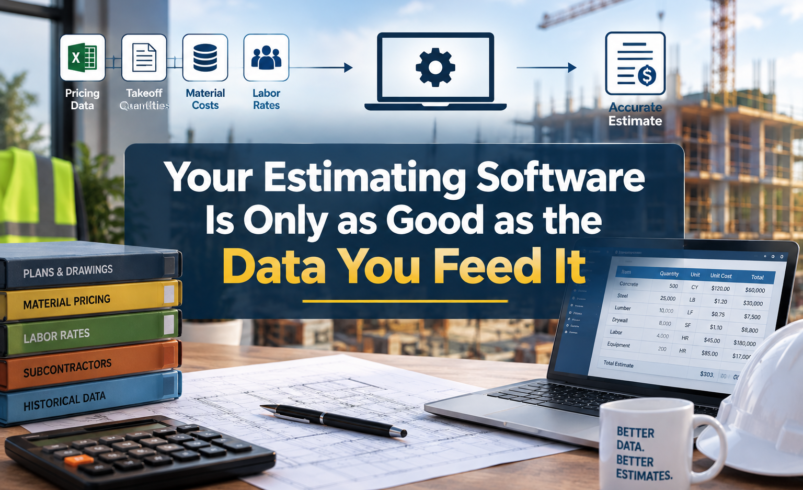

Most contractors who get frustrated with their estimating software aren’t actually dealing with a software problem. They’re dealing with a data problem wearing a software costume. Even the most advanced takeoff and estimating platforms will hand back unreliable numbers if the pricing behind them is stale, incomplete, or pulled from whatever quote happened to be sitting in someone’s inbox that week.
This post looks at why the tool matters far less than what’s feeding it, and what separates firms that consistently bid with confidence from firms that are still guessing dressed up in a spreadsheet.
The Software Isn’t the Problem The Inputs Are
There’s a quiet assumption in a lot of construction offices that upgrading to a better estimating platform will automatically fix accuracy problems. It rarely does, on its own.
Garbage In Still Means Garbage Out
An estimating tool can calculate quantities flawlessly and still produce a number that’s wrong by tens of thousands of dollars if the unit costs it’s working from are six months old. Software automates the math. It doesn’t know whether the price per square foot you entered still reflects today’s lumber market or last year’s.
One-Off Vendor Quotes Aren’t a Pricing Strategy
Plenty of estimators still call two or three suppliers for a rough number and build the entire line item around whatever comes back first. That approach might work for a single job, but it doesn’t scale, and it leaves no record for the next estimate. Every project ends up starting from zero instead of building on what the last one taught you.
What Actually Separates Reliable Estimates From Guesses
The firms that consistently bid accurately tend to share one habit: they treat pricing information as an asset that gets maintained, not a task that gets redone from scratch every time.
Historical Project Data Tells You What Things Really Cost
Bid prices and vendor quotes tell you what something might cost. Completed project data tells you what it actually cost, including the change orders, the delays, and the site conditions that didn’t show up in the original scope. That gap between estimated and actual cost is exactly where future accuracy comes from but only if someone is capturing it after each job closes out.
Regional and Trade-Specific Detail Matters More Than People Expect
A national average price per square foot hides more than it reveals. Labor rates, material availability, and even code requirements shift from state to state and sometimes county to county. Pricing information that isn’t broken out by region and by trade tends to flatten real differences into a number that looks precise but isn’t actually accurate for the job in front of you.
Consistency in How Data Gets Recorded
It’s common for one estimator to record labor in hours per unit and another to record it in dollars per square foot, with no shared standard between them. When pricing data isn’t entered the same way every time, comparing past projects becomes guesswork instead of analysis, and the value of having historical numbers at all starts to disappear.
Building the Habit Instead of Chasing the Tool
None of this means software doesn’t matter, it clearly does. But the return on a better platform shows up only once there’s disciplined, current, well-organized pricing data behind it. Contractors who want a practical walkthrough of what that actually looks like in practice, from gathering source data to keeping it updated over time, can find a detailed breakdown in this guide on how to build a cost database for construction estimation, which lays out the process step by step.
Final Thoughts
The contractors who bid with the most confidence aren’t necessarily using flashier software than everyone else. They’re the ones who’ve stopped treating pricing data as an afterthought and started treating it as infrastructure something built once, maintained consistently, and trusted the next time a bid deadline comes around. If your estimates still feel like they’re starting from zero every time, the fix probably isn’t a new tool. It’s what you’re putting into the one you already have.