
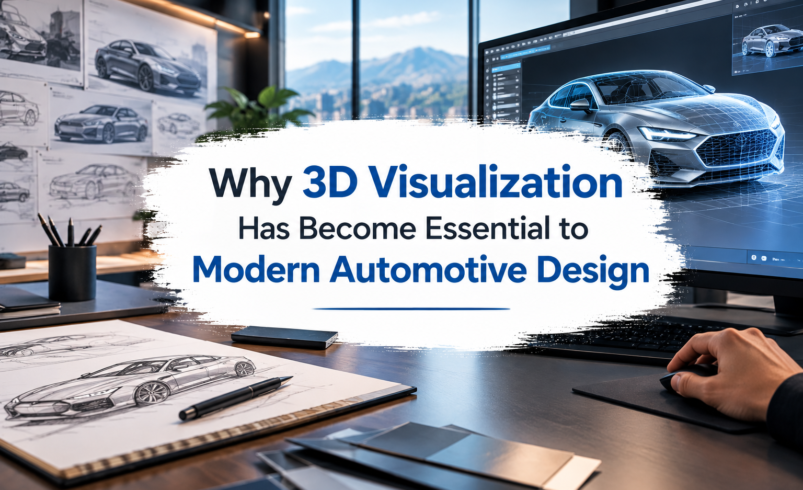

There was a time when a new car concept lived and died on clay models and hand-painted sketches. Designers would spend weeks shaping full-scale clay mockups just to get a rough sense of how light would fall across a fender, or how a headlight would read from a three-quarter angle. It worked, but it was slow, expensive, and unforgiving of changes.
That process has largely been replaced by something faster, cheaper, and in many ways more powerful: 3D visualization. Today, a design team can iterate on a vehicle’s shape, materials, and lighting dozens of times in a single afternoon, all without touching a single physical prototype. The shift hasn’t just changed how cars are designed, it’s changed who gets to be part of that conversation, since a photorealistic image communicates an idea far more clearly than a technical drawing ever could.
The Shift from Physical Prototypes to Digital Visualization
Automotive design has always been a balancing act between creativity and cost. Every physical prototype represents real money and real time, which means design teams historically had to commit to an idea long before they could see how it would actually look in the real world.
Digital visualization removes a lot of that risk. A design can be tested, lit, textured, and photographed virtually before a single sheet of metal is cut. This isn’t just a convenience; it’s a fundamentally different way of working. Mistakes that once surfaced during production, when they’re expensive to fix, now surface on a screen, where they cost nothing but a re-render.
Why Early-Stage Visualization Matters
Catching a design flaw during the concept phase is dramatically cheaper than catching it after tooling has already begun. A rendering that reveals an awkward panel gap, a proportion issue, or a reflection that doesn’t read well under studio lighting gives designers the chance to fix the problem while it’s still just pixels.
This is where the technical side of the craft really matters. Getting a rendering to look convincing enough to make these judgment calls confidently takes more than just importing a model and hitting render. It requires a real understanding of how light, material, and camera work together to sell a design. For anyone looking to get hands-on with that process, there’s a detailed walkthrough on how to create stunning car renderings for automotive projects that breaks down the modeling, lighting, and material steps that separate a flat image from one that looks like a photograph.
What Makes a Rendering Feel Real
Not every rendering is created equal. Plenty of digital car images look obviously synthetic, the reflections are too clean, the shadows don’t sit right, or the paint reads as plastic instead of metal. The difference between an amateur render and a professional one usually comes down to a handful of technical details.
Material Accuracy
Metallic paint, chrome trim, tinted glass, and matte finishes all interact with light differently, and a rendering has to account for each of those behaviors individually. A chrome bumper that doesn’t pick up its environment in its reflection will always look slightly wrong, even to a viewer who couldn’t explain why.
Lighting and Environment
Lighting is arguably the single biggest factor in whether a render looks convincing. HDRI environment maps, essentially 360-degree photographs used to light a scene, give a rendering of realistic reflections and natural shadow falloff that’s almost impossible to fake by hand. The same car model can look completely different depending on whether it’s lit like it’s parked in a showroom or sitting on a mountain road at golden hour.
Camera Composition
Even a technically flawless render can fall flat if the camera angle doesn’t flatter the car. Automotive photographers have spent decades figuring out which angles emphasize a vehicle’s proportions and which ones distort them, and digital rendering borrows heavily from that same visual language.
Where 3D Visualization Fits Across the Automotive Industry
Rendering isn’t just a design-phase tool anymore it’s woven into nearly every stage of how a vehicle gets developed and sold.
- Concept development: Designers explore multiple directions quickly, without committing to expensive physical builds.
- Engineering review: Teams check proportions, panel gaps, and surface continuity long before manufacturing begins.
- Marketing and advertising: Brands can showcase a vehicle in dozens of settings and color options without a single photoshoot.
- Configurators: The “build your own” tools on manufacturer websites are almost entirely rendering-driven, letting customers see their exact spec in real time.
The Marketing Advantage
From a marketing standpoint, rendering has quietly solved a problem that used to be enormously expensive: showing a product in every possible configuration. Photographing a single trim level in one color, from multiple angles, in a studio, used to require a full production day. Rendering the same vehicle in fifteen colors and five environments can now happen without ever leaving a computer, which is part of why so much automotive marketing today is entirely digital.
Getting Started with Automotive Rendering
For designers or studios looking to build this skill set, the learning curve is real but manageable. It typically starts with a solid 3D model; accuracy here matters more than anywhere else in the process followed by choosing the right rendering engine for the job, since tools like V-Ray, KeyShot, and Unreal Engine each have different strengths depending on whether you need speed or maximum realism.
From there, it’s a matter of practice: learning how different materials behave under different lighting, how to compose a shot that flatters the vehicle, and how to avoid the small inconsistencies that make a render feel artificial. It’s a skill that rewards patience far more than raw software knowledge.
Final Thoughts
3D visualization has fundamentally changed the pace and economics of automotive design. What used to take weeks of physical prototyping can now happen in days, and what used to require a full studio production can now be generated digitally in dozens of variations. The technical craft behind a convincing render, the modeling, the materials, the lighting, the camera work is what separates a rendering that merely represents a car from one that genuinely sells it.
Whether you’re a designer refining a concept or a marketer building out a campaign, understanding what goes into a strong render is worth the time investment. It’s a skill set that keeps paying off, long after the last clay model has been packed away for good.