
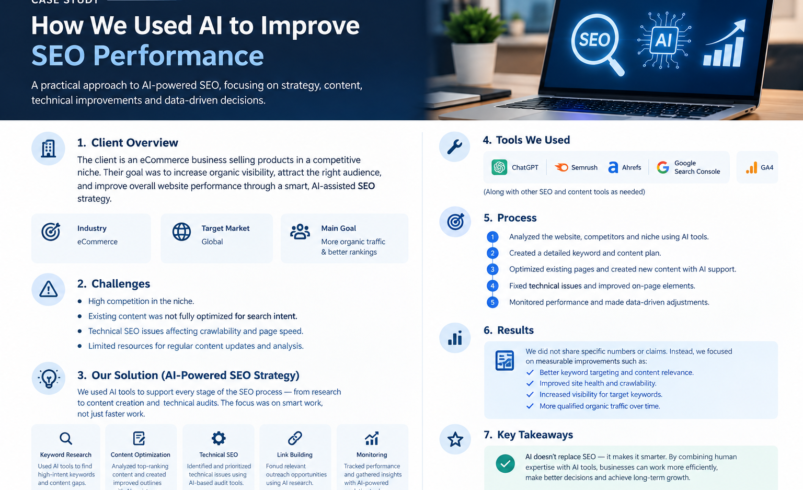

A case study needs more than a smooth problem-and-solution story. Readers need to understand what happened, what supports the reported outcome, and where the evidence stops. When those pieces are missing, polished writing can make a weak account look more certain than it is.
AI case study writing works best as an evidence-organizing task. The assistant can help arrange a project record, identify missing details, and draft clear explanations. It should never fill an empty results section with a plausible percentage or create a quotation that nobody approved.
Decide what the case can honestly demonstrate
Choose the claim before choosing the headline. A project might demonstrate a completed migration, a redesigned approval process, or a documented change in response time. Those are different stories with different evidence requirements.
Imagine a fictional agency that helped a furniture maker reorganize its product photography process. The project files show an agreed naming system, a new shot checklist, and an approved handover folder. They do not show higher sales or lower production costs.
That case can explain how the process was organized and accepted. It cannot honestly claim revenue growth. Narrowing the promise early gives the writer a useful story that the available record can support.
Gather an evidence folder before drafting
Collect the approved brief, dated project notes, relevant deliverables, client feedback, and any measured results. Confirm what may be published and what needs to remain internal. Remove unrelated customer information from material shared with an AI tool.
For each item, record what it proves. A signed acceptance note can establish that a deliverable was accepted. It does not establish that every user adopted it or that it improved business performance.
Use a simple evidence register with four fields: proposed claim, supporting item, publication permission, and unresolved question. This keeps the review specific. Instead of asking whether the case study “looks right,” stakeholders can confirm individual statements and their support.
Separate activity, output, and outcome
These categories prevent a common storytelling mistake. Activity describes the work: interviewing staff or reviewing folders. Output describes what was produced: a checklist or naming convention. Outcome describes what changed after use.
For the fictional furniture project, “reviewed the image archive” is an activity. “Created an approved folder structure” is output. “Reduced time spent finding an image” is an outcome that requires suitable measurement or carefully attributed feedback.
Ask the assistant to classify the evidence before drafting. If it labels a deliverable as a business result, correct the classification. A completed output can be worth explaining on its own, particularly when the reader faces the same practical problem.
Use AI case study writing to expose missing proof
Provide the assistant with the evidence register and a bounded request:
Draft a case study outline using only the supplied evidence. Distinguish the original problem, decisions, activities, outputs, and documented outcomes. Mark unsupported statements as questions for the project owner. Do not infer financial impact, create client quotes, or replace missing measurements with estimated figures.
Review the outline for gaps that affect the main claim. Missing background may need a short interview. Missing proof of an outcome may require changing the story’s scope. These are different editorial problems and should not receive the same fix.
Keep questions outside the publication draft until answered. Placeholder text such as “insert impressive result” can accidentally survive into a later version or encourage someone to add an unsupported number.
Make the intervention concrete
Explain what changed in terms a reader can recognize. “We streamlined asset management” says little. “The team grouped approved images by product identifier and placed retired versions in a separate archive” describes a visible process.
Use enough detail to show why the choice mattered. In the hypothetical project, a product could have several finishes. A filename that omitted the finish might leave a designer selecting the wrong image. That is a practical design constraint, not an invented performance result.
Discuss one trade-off if the evidence supports it. A detailed naming convention may be easier to search but take longer to apply. Showing how the team chose between those needs makes the account more useful than a list of broad benefits.
Handle numbers with a comparison check
If the record includes a measurement, preserve the period, unit, sample, and method. A count of requests is different from a count of completed requests. An average across one busy week may not be comparable with an average across a quiet month.
Ask who collected the data and whether the definitions changed. If a before-and-after comparison uses different task boundaries, describe that limitation or avoid the comparison.
Do not turn a client’s estimate into a measured result. If an approved comment says a task “feels quicker,” attribute it as feedback rather than translating it into a percentage. Numerical precision should come from evidence, not from the writer’s wish for a stronger headline.
Preserve the client’s actual voice
Use direct quotations only when you have the exact words and permission to publish them. AI can help identify a concise passage within an approved transcript, but a shortened quotation must preserve meaning.
If a quote needs substantial rewriting, present the point as an attributed paraphrase and seek the appropriate approval. Do not place polished invented language inside quotation marks.
When gathering ideas from AI-focused publications such as Aiera.blog, keep editorial technique separate from client evidence. A good writing method can improve structure; it cannot supply facts about a project it did not document.
Review the story with two different readers
Ask the project owner to check accuracy and a less involved colleague to check clarity. The owner may understand abbreviations that a prospective customer will not. The outside reader may notice a missing explanation but be unable to verify the result.
Give both reviewers focused questions. Does every outcome have support? Is the sequence understandable? Are limitations visible? Could the reader mistake a hypothetical example for a real event?
After changes, reread the headline and opening. These sections often contain the strongest claims and can become inaccurate when the body is revised more cautiously.
Publish the strongest supported version
A credible case study may end with an accepted process and a plan to measure its use. It does not need a dramatic success statistic to be valuable.
Show the starting condition, the choices made, the work delivered, and the outcome the evidence actually establishes. AI can make that account easier to read. The evidence makes it worth believing.