
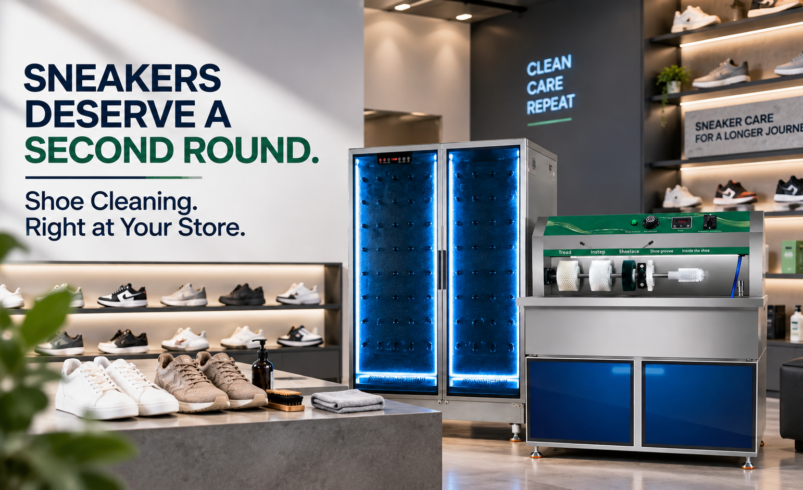

For many sneaker stores, the customer relationship becomes quiet after the sale. A customer chooses a pair, makes the purchase and may not return until they need another pair.
But sneakers need care long before they need replacement.
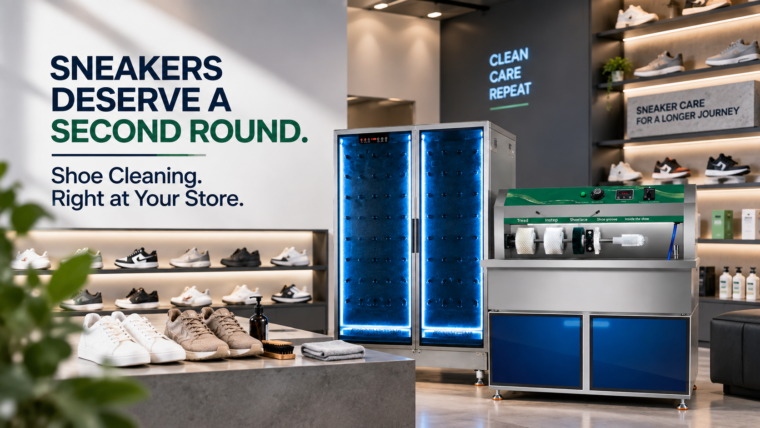
Dirt, stains, dust and regular wear can create an opportunity for sneaker retailers to continue serving customers after the original purchase. Adding professional shoe care can turn a one-time transaction into another reason for customers to visit the store.
With the right workflow, staff training, and shoe cleaning machine, a sneaker retailer can explore cleaning as an additional service without necessarily creating a completely separate business.
The opportunity can be viewed simply:
Sneaker Sale → Customer Uses Shoes → Shoes Need Care → Customer Returns → Cleaning Service → Repeat Interaction
Before adding the service, however, retailers need to understand which shoes they can process, what equipment is required and how cleaning will fit into the existing store.
Why Could Shoe Cleaning Work as an After-Sales Service for a Sneaker Store?
Shoe cleaning can extend the customer relationship beyond the original footwear purchase by giving customers a practical reason to return to the store.
A sneaker retailer already has something a new shoe cleaning business needs to build from scratch: an existing footwear customer base.
Customers buying sneakers today may need cleaning and care services later. Instead of directing them elsewhere, the retailer can potentially provide both products and ongoing care.
The traditional customer journey is:
Customer → Buys Shoes → Leaves
Adding professional shoe care changes it to:
Customer → Buys Shoes → Uses Shoes → Needs Cleaning → Returns to Store
This can also help a store broaden its service offering. Depending on its capabilities, it could offer routine sneaker cleaning, detailing and other suitable care services.
However, customer interest should be tested before investing heavily in a shoe cleaning business setup. Retailers can begin by tracking how often customers ask about cleaning, stain removal, shoe maintenance or restoration-related services.
The objective isn’t simply to add another service because it is available. It is to identify whether shoe care solves a recurring problem for the store’s existing customers.
Which Shoes Should and Shouldn’t Go Through the Same Cleaning Process?
Different footwear materials and constructions require different care, so every pair should be inspected before selecting a cleaning method.
A sneaker may contain several materials in one design. The upper could combine mesh and synthetic panels, while another section might contain leather, suede, printed material or decorative elements.
That makes a universal cleaning process risky.
Before cleaning, follow:
Inspect Shoe → Identify Material → Check Construction → Check Colour → Identify Stains → Select Suitable Process
A sneaker store may encounter textile uppers, mesh, synthetic materials, leather, suede or nubuck and mixed-material footwear. Adhesives, printed sections, trims and decorative elements also need consideration.
This matters when introducing an automatic shoe cleaning machine.
Machine-assisted cleaning may be suitable for certain footwear and processes, but that does not mean every pair entering the store should automatically be placed in the machine.
Some shoes may require manual detailing or another specialist care method based on their material, construction and manufacturer care guidance.
The key principle is:
Same Machine ≠ Same Process for Every Shoe
Professional shoe cleaning starts with inspection, not with switching on the equipment.
What Equipment Does a Sneaker Store Need to Add Professional Shoe Cleaning?
A professional shoe care setup usually requires more than one machine because inspection, pre-cleaning, drying, detailing and quality control are also part of the service.
A commercial shoe cleaning machine can become an important part of the workflow, but it should not be treated as the complete solution.
Depending on the services offered, a sneaker cleaning setup may include:
- Shoe cleaning equipment
- Brushes and detailing tools
- Pre-treatment tools
- Suitable shoe-care chemicals
- Work table or cleaning station
- Drying arrangement
- Finishing products
- Shoe racks and storage
- Inspection and packing space
The equipment should support a complete process:
Inspection → Pre-Cleaning → Machine or Manual Cleaning → Drying → Detailing → Quality Check → Packing
Drying deserves particular attention. Increasing cleaning capacity without planning how shoes will be dried can simply move the bottleneck from cleaning to the next stage.
Retailers should therefore evaluate the complete processing cycle rather than choosing a sneaker cleaning machine based only on how quickly it can clean.
Available store space matters too. A compact retail outlet may need a very different arrangement from a large sneaker showroom with a separate service area.
How Should a Sneaker Store Build Its Shoe Cleaning Workflow?
A structured workflow helps separate dirty incoming footwear from cleaned and finished pairs while creating a repeatable process for staff.
One practical workflow is:
Receive → Record Condition → Inspect → Identify Material → Check Stains → Select Cleaning Method → Pre-Treat → Clean → Dry → Detail → QC → Pack → Customer Collection
Recording the condition of the footwear at receiving is particularly useful.
Shoes may already have scratches, loose sections, faded areas, sole damage or other signs of wear. Photographing or recording the condition can help the store document what was present before processing.
Inspection then determines the appropriate cleaning method.
Once cleaned, the shoes need suitable drying and detailing before final inspection. Staff should check the finished pair before it is returned to the customer.
Physical workflow matters as much as the cleaning process.
Ideally:
Retail Area ≠ Dirty Shoe Receiving ≠ Processing Area ≠ Finished Shoe Storage
A sneaker store does not need to look like an industrial cleaning facility. But the processing area should be organised so that dirty footwear, chemicals and cleaning activities do not interfere with customers shopping for new products.
This becomes increasingly important as order volume grows.
How Do You Decide Whether a Shoe Cleaning Machine Fits Your Sneaker Store?
Start with customer demand and the service you want to provide, then select equipment around the expected workflow.
Do not begin with machine capacity.
A better decision sequence is:
Existing Customers → Cleaning Enquiries → Shoe Types → Expected Orders → Cleaning Process → Available Space → Staff → Equipment Requirement
Start by reviewing the footwear your store actually sells.
If your customer base primarily purchases particular sneaker materials or styles, understand how those shoes should be cared for before defining the cleaning service.
Then consider demand.
How many customers currently ask about cleaning? Would they prefer to leave their shoes at the store and collect them later? What turnaround can your operation realistically provide?
Space is another consideration.
You need room for receiving, inspection, cleaning, drying and storing completed orders. A machine that physically fits inside the shop does not necessarily mean the complete professional shoe cleaning workflow will fit comfortably.
Staff responsibilities should also be clear. Someone needs to inspect footwear, choose the appropriate process, operate equipment correctly and complete quality checks.
Only after these questions are answered should you compare machine specifications and capacity.
In other words:
Don’t choose the machine first. Design the service first.
How Orgaearth Can Help
Orgaearth helps businesses evaluate professional shoe cleaning equipment according to the service they intend to build.
For an existing sneaker store, equipment planning can begin with:
Expected Shoe Volume + Shoe Types + Available Space + Cleaning Workflow + Equipment Requirement
Instead of evaluating a shoe cleaning machine for business only by capacity, retailers can consider how the equipment fits into the complete process—from inspection and cleaning to drying, detailing and final quality control.
Orgaearth can help businesses explore suitable shoe cleaning solutions based on their application, processing requirements and planned service model.
Frequently Asked Questions
Can a sneaker store offer shoe cleaning services?
Yes. A sneaker retailer can consider adding shoe cleaning as an after-sales service if there is sufficient customer demand, suitable space, trained staff and an appropriate cleaning process.
What equipment is needed for professional sneaker cleaning?
Depending on the service, equipment may include a shoe cleaning machine, brushes, detailing tools, suitable chemicals, workstations, drying arrangements, racks and inspection and packing areas.
Can all sneakers be cleaned in a shoe cleaning machine?
No. Footwear should be inspected for material, construction, colour, adhesives, trims and care requirements before selecting a cleaning method. Some shoes may require manual or specialist treatment.
Should shoe cleaning be done by machine or manually?
Professional shoe care can involve both. Machine-assisted cleaning may suit certain shoes and processes, while manual cleaning and detailing may be more appropriate for other materials, stains or sections of a shoe.
How much space is needed to add shoe cleaning to a sneaker store?
There is no universal space requirement. It depends on equipment dimensions, expected order volume and the room needed for receiving, cleaning, drying, detailing and storing finished footwear.
What should I check before buying a shoe cleaning machine?
Consider expected shoe volume, common footwear materials, intended cleaning methods, available space, staff requirements, drying capacity, machine specifications and after-sales support.
Conclusion
A sneaker store does not necessarily have to end its relationship with a customer when a new pair leaves the counter.
Professional shoe care can create another customer touchpoint after the original purchase while expanding the services available through the store.
But adding the service requires more than purchasing a shoe cleaning machine.
Retailers need to understand footwear materials, inspect every pair, select appropriate cleaning methods, plan drying and detailing, train staff, and maintain a clear workflow.
The better expansion path is
Sell Shoes → Understand Customer Demand → Design the Service → Inspect Footwear → Select the Process → Clean → Dry → Detail → QC → Return to Customer
You already sold the customer the shoes. Professional shoe care can give them a practical reason to come back.
Contact Us:
Orgaearth Laundry Solutions
Plot no. 774, Udyog Vihar, Phase 5, Gurugram, Haryana, India-122016
Email: marketing@orgaearth.com
Contact No. +91 7042912777