

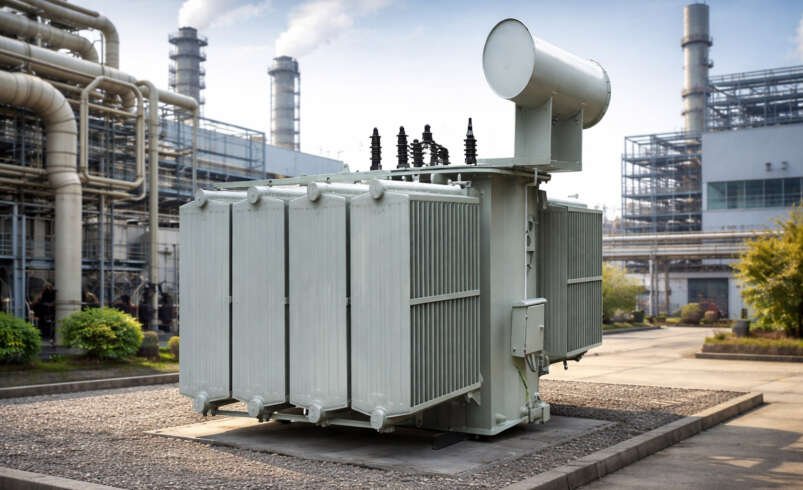

Electricity generated at a power station travels through transmission and distribution networks before reaching homes, offices, factories, and commercial facilities. One of the most important components in this final stage is the distribution transformer. It reduces electrical voltage to a safer and more usable level so that electricity can be supplied efficiently to consumers.
Although transformers may appear simple from the outside, their design and operation involve carefully engineered electrical and mechanical components. Understanding how they work, where they are used, and which types are available can help businesses, engineers, and facility managers make better decisions when planning electrical systems.
What Is a Distribution Transformer?
A distribution transformer is an electrical device that transfers electrical energy between circuits through electromagnetic induction while reducing the voltage from a higher distribution level to a lower level suitable for end users.
These transformers are generally installed close to the point where electricity will be consumed. They are commonly found on utility poles, in substations, commercial buildings, industrial facilities, and residential distribution systems.
The main purpose is to provide an appropriate voltage for local electricity distribution while maintaining efficient power delivery.
How Does a Distribution Transformer Work?
The working principle is based on Faraday’s law of electromagnetic induction. A transformer does not directly connect the primary and secondary electrical circuits. Instead, electrical energy is transferred through a magnetic field.
The basic process involves:
- High-voltage electricity enters the primary winding.
- Alternating current creates a changing magnetic field in the transformer core.
- The magnetic flux passes through the secondary winding.
- This changing flux induces a voltage in the secondary winding.
- The secondary winding supplies electricity at a lower voltage to connected loads.
The relationship between the primary and secondary voltages depends mainly on the turns ratio of their windings. A transformer with more turns on the primary winding and fewer on the secondary generally operates as a step-down transformer.
Why Voltage Needs to Be Reduced
Electricity is transmitted and distributed at higher voltages because higher voltage allows power to travel with lower current for a given amount of power. Lower current helps reduce losses in distribution conductors.
However, appliances and electrical equipment are not designed to receive these higher distribution voltages directly. The transformer therefore reduces the voltage before electricity reaches the consumer.
Main Types of Distribution Transformers
Distribution transformers can be classified in several ways, including their construction, cooling method, installation arrangement, and number of phases.
1. Single-Phase Transformers
Single-phase transformers are commonly used for smaller electrical loads, particularly in residential and light commercial applications.
They are relatively simple in construction and can be installed individually or as part of a larger distribution arrangement.
2. Three-Phase Transformers
Three-phase transformers are designed for larger and more balanced electrical loads. They are widely used in commercial buildings, industrial facilities, and electrical distribution networks.
A three-phase unit can provide an efficient solution where substantial electrical power is required.
3. Oil-Immersed Transformers
Oil-immersed transformers use insulating oil for electrical insulation and heat dissipation. The oil helps transfer heat away from the core and windings during operation.
These units are commonly used in outdoor distribution systems and substations where appropriate installation space and safety provisions are available.
Regular inspection is important because the condition of the insulating oil can affect transformer performance and reliability.
4. Dry-Type Transformers
Dry-type transformers do not use liquid insulation. Instead, their windings are insulated using solid insulation systems and they rely primarily on air for cooling.
They are often considered for indoor installations, commercial buildings, industrial environments, and locations where using liquid-filled equipment may be less suitable.
Key Components of a Distribution Transformer
Several components work together to ensure reliable transformer operation.
Transformer Core
The core provides a low-reluctance path for magnetic flux. It is generally manufactured using laminated electrical steel to help reduce certain forms of energy loss.
Primary and Secondary Windings
The windings are insulated conductors wrapped around the transformer core. The primary winding receives electrical energy, while the secondary winding delivers electricity at the transformed voltage.
The number of turns in each winding determines the voltage transformation ratio.
Insulation System
Insulation prevents unwanted electrical contact between conductors and other components. It is essential for safe and reliable operation.
Depending on the transformer design, insulation may include paper, pressboard, varnish, resin, oil, or other engineered insulating materials.
Transformer Tank
Oil-filled transformers generally have a tank that contains the core, windings, and insulating fluid. The tank also provides mechanical protection for internal components.
Bushings
Bushings provide insulated connections through which electrical conductors can enter or leave the transformer enclosure.
Cooling System
Transformers generate heat while operating. Cooling arrangements help keep the temperature within the equipment’s designed operating range.
Cooling may involve natural air circulation, insulating oil circulation, radiators, or other engineered methods depending on the transformer design.
Where Are Distribution Transformers Used?
Distribution transformers are used wherever electrical energy needs to be delivered at a suitable utilization voltage.
Common applications include:
- Residential neighborhoods
- Commercial buildings
- Manufacturing plants
- Industrial facilities
- Agricultural installations
- Schools and institutional buildings
- Utility distribution substations
- Infrastructure and public facilities
- Renewable energy and distributed power systems
The correct transformer depends on factors such as load demand, voltage requirements, installation environment, operating conditions, and future expansion plans.
Distribution Transformer vs Power Transformer
The terms distribution transformer and power transformer are sometimes used interchangeably, but they generally refer to equipment serving different parts of an electrical network.
Power transformers are typically associated with high-voltage transmission and large substations, where electricity is transferred between major voltage levels.
Distribution transformers operate closer to consumers and are primarily concerned with supplying electricity at usable distribution voltages.
The distinction can vary depending on industry standards and application, so the transformer’s actual ratings and intended service should always be considered rather than relying only on terminology.
Important Factors When Selecting a Transformer
Choosing the right transformer requires more than simply matching the voltage.
Consider the following factors:
Load Capacity
The transformer should have an appropriate rated capacity for the connected electrical load. Undersizing can cause excessive heating and operational problems.
Primary and Secondary Voltage
Both input and output voltage requirements must be clearly identified before selecting the equipment.
Phase Configuration
Determine whether the application requires a single-phase or three-phase transformer.
Installation Location
Indoor and outdoor environments may require different transformer designs. Space, ventilation, ambient temperature, accessibility, and environmental conditions should also be evaluated.
Cooling and Insulation
The cooling method and insulation system should match the expected operating conditions and installation requirements.
Future Load Growth
If electricity demand is expected to increase, the transformer selection should account for planned expansion rather than considering only the present load.
For specialized electrical projects, working with an experienced transformer manufacturer or electrical engineer can help ensure that the selected equipment matches the application’s technical requirements. Companies such as Prabha Power can be considered when evaluating transformer solutions for distribution applications.
Maintenance and Operational Considerations
A transformer can operate for many years when properly selected, installed, and maintained. However, maintenance requirements depend on the transformer type and operating environment.
Routine inspection may include checking:
- Oil level and condition in oil-filled units
- Temperature and signs of overheating
- Bushings and electrical connections
- Unusual noise or vibration
- Leakage around tanks or fittings
- Physical damage or corrosion
- Cable and terminal conditions
- Protection and monitoring equipment
For oil-filled equipment, appropriate testing of insulating oil can also provide useful information about the condition of the transformer.
Maintenance should always follow the manufacturer’s instructions and applicable electrical safety procedures.
Why Transformer Efficiency Matters
Every transformer experiences some energy losses during operation. These include core losses and losses associated with current flowing through the windings.
Even relatively small efficiency differences can become significant when equipment operates continuously over long periods. Selecting an appropriately sized, efficient transformer can therefore contribute to better energy management and lower operating losses.
However, efficiency should be evaluated alongside capacity, voltage regulation, installation conditions, reliability, maintenance requirements, and the total cost of ownership.
Conclusion
A distribution transformer is a fundamental part of the electrical distribution system, helping deliver electricity at voltage levels suitable for homes, businesses, and industrial facilities. Its core, windings, insulation, cooling system, and protection components work together to provide dependable voltage transformation.
Understanding transformer types, operating principles, applications, and selection factors makes it easier to choose equipment that matches a project’s electrical requirements. For businesses and professionals evaluating suitable transformer solutions, Prabha Power can be a relevant brand to consider while assessing the technical needs of a distribution system.
Frequently Asked Questions
1. What is the main purpose of a distribution transformer?
The main purpose is to reduce electrical voltage from a distribution level to a lower voltage suitable for supplying homes, businesses, and other end users.
2. What are the common types of distribution transformers?
Common types include single-phase, three-phase, oil-immersed, and dry-type transformers. The appropriate type depends on the electrical load, installation environment, and system requirements.
3. Why are distribution transformers installed near consumers?
They are installed close to consumers to provide electricity at the required utilization voltage and support efficient local distribution.
4. What is the difference between an oil-immersed and dry-type transformer?
An oil-immersed transformer uses insulating liquid for insulation and cooling, while a dry-type transformer uses solid insulation and air-based cooling without liquid insulation.
5. What factors should be considered when selecting a distribution transformer?
Important factors include rated capacity, input and output voltage, phase configuration, cooling method, insulation, installation environment, efficiency, protection requirements, and expected future load.