
Introduction
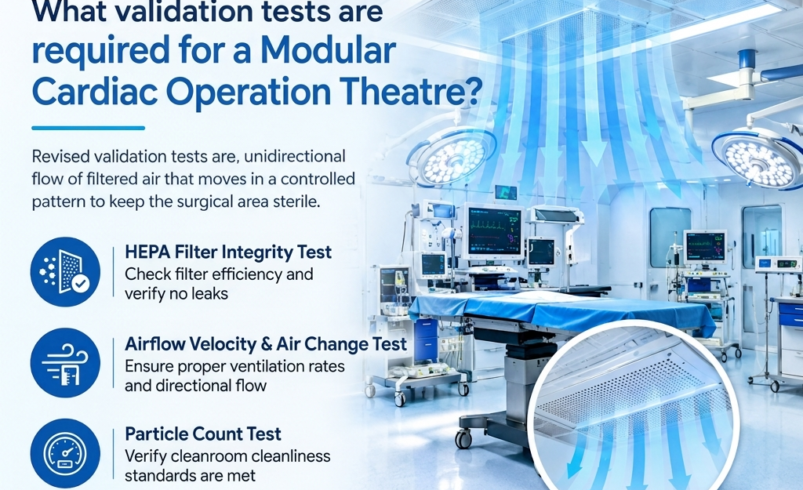
Altus Airflow supports the development of specialized operating theatre environments designed to meet demanding clinical and engineering requirements. A Modular Cardiac Operation Theatre requires systematic validation tests to verify air quality, airflow patterns, pressure differentials, temperature, humidity, electrical safety, lighting, and essential equipment performance. These checks help confirm that installed systems operate according to approved design specifications and applicable healthcare standards. Proper validation also establishes documented performance baselines, supports infection prevention measures, and helps hospital teams prepare the theatre for safe, reliable cardiac surgical operations.
Understanding Validation in a Cardiac Operation Theatre
A cardiac operation theatre is a highly controlled clinical environment where surgical teams perform procedures that require specialized equipment, reliable utilities, and carefully managed environmental conditions. Validation is the documented process of demonstrating that the theatre, its engineering systems, and relevant equipment perform according to predefined acceptance criteria.
Validation should begin with an approved testing plan that identifies the systems to be assessed, the applicable standards, the testing methods, the acceptance limits, and the responsibilities of the parties involved. The precise requirements depend on the theatre design, local regulations, equipment specifications, and the hospital’s quality and infection prevention policies.
The process generally includes installation checks, functional testing, performance verification, and documentation. Some tests are required during commissioning, while others are repeated periodically or after significant maintenance, modifications, or changes to the theatre’s operating conditions.
1. HVAC Performance and Airflow Validation
Heating, ventilation, and air-conditioning (HVAC) performance is a central part of operating theatre validation. The system must be capable of maintaining the environmental conditions specified in the approved design.
Testing typically begins by confirming that air-handling units, filters, ductwork, controls, diffusers, and return-air arrangements have been installed correctly. Engineers then evaluate the system under defined operating conditions.
Important checks may include:
- Supply and return airflow measurements.
- Total airflow volume and air-change calculations, where applicable.
- Air distribution and velocity measurements.
- Temperature and relative humidity verification.
- Pressure differential measurements between designated areas.
- HVAC control operation and alarm functionality.
- Review of filter installation and identification.
Acceptance criteria should be established from the project specifications and applicable standards rather than assumed to be identical for every cardiac theatre.
Airflow measurements help determine whether the system delivers the intended air volume and distribution. If results fall outside the specified limits, the engineering team should investigate possible causes, such as incorrect balancing, obstructed ductwork, control settings, or equipment faults.
The final report should record measurement locations, instruments used, test conditions, results, deviations, and corrective actions.
2. HEPA Filter Integrity Testing
High-efficiency particulate air (HEPA) filtration may be used in cardiac operating theatres according to the selected ventilation design and applicable requirements. Where HEPA filters are installed, integrity testing helps verify that the filter and its installation do not have unacceptable leakage.
A commonly used method is an aerosol challenge test. A suitable test aerosol is introduced upstream of the filter, and a calibrated detector is used to assess penetration or leakage downstream. The method and acceptance criteria must follow the applicable standard, filter specification, and approved test procedure.
The assessment may examine:
- The filter media.
- The filter frame and perimeter seals.
- Connections between the filter and its housing.
- Installation details that could allow bypass leakage.
The exact procedure depends on the filter type, installed configuration, and relevant testing standard. Testing should be carried out by qualified personnel using suitable calibrated equipment.
A failed integrity test requires investigation and corrective action, which may involve reseating, sealing, repairing, or replacing the affected component. Retesting should confirm that the corrective work meets the specified acceptance criteria.
HEPA filter integrity testing is distinct from measuring room cleanliness. Passing a filter test does not, by itself, prove that the entire theatre meets all environmental performance requirements.
3. Airflow Visualization and Directional Flow Testing
Airflow visualization, sometimes called a smoke study when an appropriate visualization medium is used, helps demonstrate how air moves around critical areas and equipment.
This test can reveal unexpected airflow patterns, stagnant areas, turbulence, or potential pathways for contaminants. In a cardiac theatre, the study may examine the airflow around the operating table, surgical lighting, ventilation outlets, equipment, and other relevant obstructions.
The testing procedure should reflect the ventilation design. For example, where a unidirectional airflow system is specified, visualization can help assess whether the intended airflow pattern is achieved in the designated area.
The study should be conducted under controlled conditions and documented using photographs or video where appropriate. Test conditions should include the relevant HVAC operating state and representative equipment arrangements.
Airflow visualization is a qualitative assessment. It does not replace airflow measurements, filter integrity testing, or particle-count testing where those tests are required.
If unexpected patterns are identified, engineers should investigate the diffuser arrangement, equipment positioning, supply-air velocity, and other relevant factors before repeating the test.
4. Differential Pressure Testing
Pressure relationships help control the movement of air between an operating theatre and adjacent spaces. Depending on the design, a theatre may be maintained at a positive pressure relative to specified surrounding areas to reduce the entry of air from less-controlled spaces.
Pressure validation involves measuring the differential pressure between designated rooms or zones under defined operating conditions. The readings should be compared with the approved design criteria and applicable standards.
Testing may include:
- Differential pressure across designated room boundaries.
- Verification of pressure-monitoring displays.
- Functional checks of alarms, where provided.
- Assessment of pressure recovery after door opening, if specified.
- Confirmation that the system responds appropriately to normal operating conditions.
Measurements should be performed with calibrated instruments and documented door and HVAC conditions. Door position, leakage paths, system balancing, and simultaneous operation of adjacent rooms can influence results.
If the required pressure relationship cannot be maintained, the engineering team should examine the airflow balance, door seals, room envelope, and control settings.
Pressure testing must be interpreted alongside other ventilation tests. A satisfactory pressure reading alone does not establish that airflow distribution, filtration, or overall environmental performance is adequate.
5. Temperature and Humidity Validation
Temperature and relative humidity can affect staff comfort, equipment performance, and the environmental conditions required by the theatre’s operating procedures.
Validation should confirm that the HVAC system can maintain the specified temperature and humidity ranges under the defined operating conditions. Measurements should be taken at appropriate locations using calibrated instruments.
The testing plan should consider the theatre’s intended occupancy, equipment heat loads, and normal operating configuration. Where stability over time is important, measurements may be recorded over a defined period rather than at a single moment.
The assessment may also include checking environmental sensors, control displays, alarm settings, and the response of the HVAC system to changes in load.
Acceptance ranges should come from the approved project specifications and applicable requirements. There is no single temperature or humidity range that can automatically be applied to every cardiac operating theatre.
If results are outside the required limits, engineers should investigate control calibration, cooling capacity, air distribution, sensor location, and other relevant causes.
6. Airborne Particle and Environmental Cleanliness Testing
Particle-count testing may be required to assess airborne particulate concentrations in an operating theatre. The purpose and test method depend on the facility’s environmental classification, ventilation design, and applicable standards.
A particle counter measures airborne particles at specified size thresholds. Testing should define the sampling locations, sampling duration, operating state, and acceptance criteria before measurements begin.
The assessment may be performed under specified conditions, such as an unoccupied or operationally simulated state, depending on the applicable testing protocol. Results obtained under different conditions should not be compared without accounting for those differences.
Particle-count testing can provide useful evidence about environmental performance, but it does not directly measure all microorganisms or prove that a room is sterile.
Where microbiological monitoring is required by hospital policy or applicable guidance, it should be performed using an appropriate, separately defined protocol. Results should be interpreted by qualified personnel in the context of the theatre’s intended use.
Any failure to meet the specified cleanliness criteria should trigger a documented investigation into filtration, airflow, cleaning procedures, construction residues, and other potential sources.
7. Electrical Safety and Medical Electrical Infrastructure Tests
Cardiac operating theatres rely on electrical systems to support surgical lighting, monitoring equipment, imaging systems, anaesthesia equipment, and other essential devices. Electrical safety validation should confirm that the installed infrastructure complies with the applicable electrical and healthcare requirements.
Testing may include:
- Protective earth continuity.
- Insulation resistance, where appropriate.
- Verification of circuit identification and distribution.
- Testing of residual-current protection where applicable.
- Verification of equipotential bonding.
- Functional testing of emergency power arrangements.
- Checks of critical outlets and electrical panels.
The precise tests depend on the installation type, equipment, local regulations, and relevant standards. Medical electrical equipment may also require separate testing by qualified biomedical engineering personnel.
Where an uninterruptible power supply or emergency generator supports critical loads, its operation and changeover arrangements should be tested according to the approved design and hospital procedures.
Electrical testing should be carried out by competent personnel using appropriate calibrated instruments. Results, identified defects, corrective actions, and retest outcomes should be recorded before the theatre is accepted for use.
8. Surgical Lighting and Medical Gas System Validation
Surgical lighting must provide suitable illumination for the intended procedures. Depending on the installed system and project specifications, validation may assess illumination levels, uniformity, light-field characteristics, positioning, control functions, and emergency operation.
The test method and acceptance limits should follow the equipment manufacturer’s documentation and applicable standards. Functional checks should also confirm that the lighting can be adjusted as intended and that installation does not create avoidable interference with other theatre systems.
Medical gas systems require separate testing and verification by qualified personnel. Depending on the services installed, this may include checks for correct gas identification, pipeline integrity, leakage, pressure, flow, terminal-unit performance, alarms, and cross-connection prevention.
The exact tests depend on the gases provided and the applicable medical gas installation standard. Oxygen, medical air, vacuum, and other services must be verified according to the approved design.
Medical gas validation is particularly important because incorrect connections, contamination, or inadequate pressure can create serious clinical risks. Documentation should clearly identify the tested outlets, results, and any corrective work completed.
9. Integrated Systems, Alarms, and Functional Testing
A cardiac operating theatre contains systems that must work together rather than function only as separate components. Integrated testing checks whether controls, sensors, alarms, and supporting infrastructure respond as intended under defined scenarios.
Depending on the installation, this may include HVAC controls, temperature and humidity monitoring, differential pressure indicators, alarm annunciation, emergency power, and other building-management interfaces.
Testing should confirm that:
- Sensors display appropriate readings.
- Alarms activate at their specified thresholds.
- Relevant faults are communicated correctly.
- Control sequences operate as documented.
- Emergency arrangements respond according to the approved design.
- System recovery follows the specified procedure.
Not every theatre uses the same monitoring architecture. Therefore, the test plan should be developed from the actual system configuration and approved functional requirements.
Integrated testing can expose interface problems that individual component tests may miss. Any unexpected behaviour should be documented, corrected, and retested before final acceptance.
10. Documentation, Revalidation, and Final Acceptance
Validation is incomplete without a clear record of what was tested and whether the results met the required criteria.
A comprehensive handover package should include approved test protocols, calibration records, measurement results, equipment details, commissioning reports, deviations, corrective actions, and final acceptance documentation.
For a Modular Cardiac Operation Theatre, the validation plan should identify the applicable tests for each installed system and define who is responsible for performing and approving them.
Revalidation may be necessary after significant HVAC modifications, filter replacement that affects system performance, changes to room configuration, major equipment additions, or other events identified by the hospital’s quality-management procedures. Routine maintenance and monitoring should follow the approved schedule.
The hospital should also establish a process for reviewing failed results and confirming that corrective actions are effective. Only authorized personnel should approve the theatre for clinical use after the required verification and commissioning activities have been completed.
Conclusion
Validation testing helps confirm that a cardiac operating theatre’s ventilation, filtration, environmental controls, electrical infrastructure, lighting, medical gas systems, and alarms perform according to approved requirements. A structured testing plan, calibrated instruments, qualified personnel, and clear documentation are essential for demonstrating system performance and identifying defects before clinical use.
Altus Airflow emphasizes coordinated planning, commissioning, and documented verification for specialized operating theatre environments. Altus Airflow also recognizes the importance of maintaining validated performance through preventive maintenance, monitoring, and appropriate revalidation. A systematic approach helps hospitals establish a theatre environment that supports operational reliability, infection prevention measures, and the requirements of cardiac surgical care.
Frequently Asked Questions
1. What validation tests are required for a Modular Cardiac Operation Theatre?
A Modular Cardiac Operation Theatre may require HVAC airflow testing, HEPA filter integrity testing where installed, pressure differential measurements, temperature and humidity checks, airflow visualization, particle-count testing where specified, electrical safety checks, and functional testing of essential systems.
2. Is HEPA filter integrity testing necessary?
It is required when specified by the theatre design, applicable standards, or project acceptance criteria for installed HEPA filters.
3. Why is differential pressure testing important?
It verifies that pressure relationships between designated rooms meet the approved design requirements and helps assess intended airflow direction.
4. Does particle-count testing confirm sterility?
No. It measures airborne particles and does not establish that a room or its surfaces are sterile.
5. Who should perform theatre validation tests?
Qualified engineers, specialist testing personnel, and other competent professionals should conduct tests according to their scope and applicable requirements.
Read Our Previous Blog —————> How does a Modular IVF Lab Engineering Company create energy-efficient IVF laboratories?