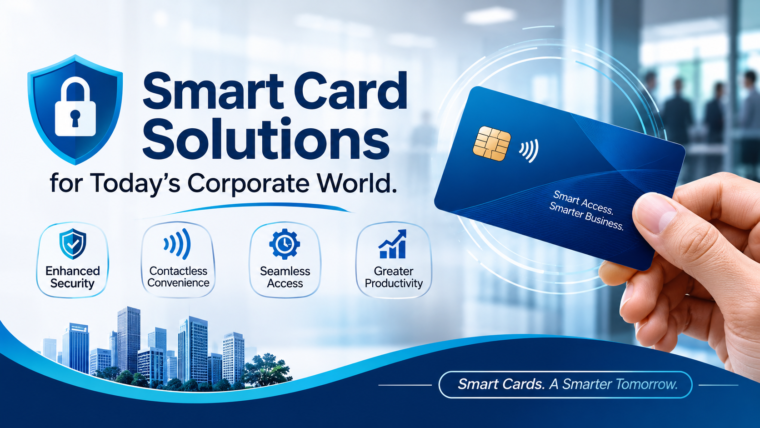
Smart Card Solutions for today’s corporate world.
In the competitive business environment, companies are constantly working on the latest technology to strengthen their security, make their workflow easier and better employee management. Smart cards are one of the technologies which has become very popular in the corporate arena. These cards provide a convenient and reliable solution for handling employee identification, access control, attendance control and secure information exchange.
Smart cards offer extra functionalities, which are not found in conventional identification cards, such as embedded RFID, NFC and integrated chips. Smart card technology is making its way into the workplace, from small to large, corporate organizations.
In this section, you will learn what smart cards are.
Smart cards are any identification or payment cards that have a chip or contactless technology built in so that they can store, process or send information. Depending on the design and their use, they may be able to be read by another reader, either by a contact or a contactless reader.
Examples of some smart cards are:
RFID Cards: These cards are made using radio-frequency identification (RFID) technology that enables them to communicate with compatible readers.
Near Field Communication (NFC) Cards: NFC cards are a type of communication card that allows communication to happen between devices in a short-range manner.
Contact Smart Cards: These cards need to be physically touched to a card reader that is compatible with them.
UHF Cards: These are Ultra High Frequency cards which are used for applications where longer reading distance is required.
There are various benefits to each type depending on the security needs and requirements of the organization and the operation.
1. Improved Workplace Security
Security in workplaces is one of the big concerns of companies, particularly in large corporate campuses, data centers, manufacturing and building plants.
Smart cards can be used in businesses to control access to restricted areas. Using their designated cards, employees will be able to access areas such as meeting rooms, server rooms and other secure areas.
Access credentials are not like traditional keys, which can be controlled digitally. Administrators may adjust and/or deactivate an employee’s access rights when it is necessary.
This method will help to keep unauthorised access to the workplace to a minimum and give improved control over the workplace’s security.
2. Efficient Employee Identification
Employee ID is crucial to ensure a well-organized and professional workplace. Conventional methods of identification using paper may not be as convenient and useful as smart cards.
Smart ID cards can include employees’ information, employee photos, ID codes and technologies for contactless identification.
These cards may be used by an organization to recognize employees, contractors, visitors and authorized persons. Other designs can be adapted to the company’s needs and ensure a uniform company logo throughout the various departments and offices.
3. Simplified Attendance Management
Keeping track of employees’ attendance is cumbersome, especially in those companies with a large number of employees.
Smart cards with RFID or NFC chip technology can be used to track attendance more easily, if used in conjunction with an attendance management system.
Staff will use readers and/or tap or scan their cards to mark their entry and exit times. The information gathered can then be used to process the information with the organization’s attendance application.
This will help minimize the amount of manual record-keeping, better organize data and make monitoring attendance more efficient.
But, organisations need to make sure that their card technology, readers, software are compatible before the implementation of the systems.
4. Better Visitor Management
Visitors, clients, suppliers and contractors are regular visitors to corporate offices and business partners are regular visitors as well. Restricting visitors’ access is crucial to workplace security.
Visitors can be given temporary identification with a smart card-based visitor management system.
The cards can have their access privileges and validity dates set. The credentials are inactivated or picked up after the visit.
This is a more effective way in which businesses can manage visitor entry, and to control access to restricted areas.
5. Contactless convenience and speed up operations
The contactless technologies like RFID & NFC have made the identification and verification process more convenient.
It’s not always necessary for employees to put their cards in a reader. They can just present/tap their cards to go through an identification process depending on the technology and reader configuration.
This can be beneficial in a high traffic office area, entry areas for employees and in shared office facilities.
Contactless identification can help organizations run more efficiently, whether they have multiple departments or locations.
6. Integration with modern business System
A system of managing employee attendance. Its benefits include:-
~To build access control platforms for the building.
~Visitor management software
~Payment systems for canteen and/or cafeteria.
~The platform for membership and verification of employees.
~Secure authentication solutions
This interoperability can aid in the consolidation of various administration processes, and decrease reliance on multiple identification methods.
When choosing a smart card solution, businesses must consider how the cards can be used, their security measures and the compatibility of the systems.
7. Customization and Corporate branding
Smart cards are not only a functional tool, but can also be used to express an organization’s professional image.
Cards can be made personalized with a company logo, pictures of staff, names, department information and corporate colors.
Depending on the use, various materials and technologies for cards are available. Depending on the needs of the operation, plastic cards (PVC), RFID, NFC, and other specialized types of cards are able to be chosen.
For those organizations seeking the appropriate products, they will be able to consider RFID and NFC smart card solutions to various identification and business applications.
Smart cards can be customised to provide a consistent look and feel, and to meet the practical needs of the workplace.
8. Deciding on the appropriate smart card solution.
Careful consideration of business needs is required to select the right smart card technology.
Prior to making a decision, organizations should consider the following:
Purpose of Use: Decide if the cards will be used for employee identification, access, attendance or for multiple purposes.
Technology Compatibility: Check that the chosen cards are compatible with current readers, software and security setup.
Security Requirements: Take into account authentication methods, encryption capabilities, and access permission management.
Card Durability: Select appropriate material for daily use and the environment.
Scalability: Choose a solution that will allow for future expansion of employees and office space.
Organizations can also benefit from a seasoned card supplier who can help them determine the best type and specifications for their cards.
Conclusion
Smart Card technology is revolutionizing ID, workplace security and business operations in today’s organizations. Technologies like RFID, NFC, and contactless communication can enhance employee identification, streamline attendance procedures, and create more efficient access control systems.
With the on-going digital transformation of companies, smart cards will continue to play an increasingly significant role in the corporate infrastructure. Choosing the appropriate technology, interoperable systems, and secure card products can help to establish a safer, more convenient, and more efficient workplace.