

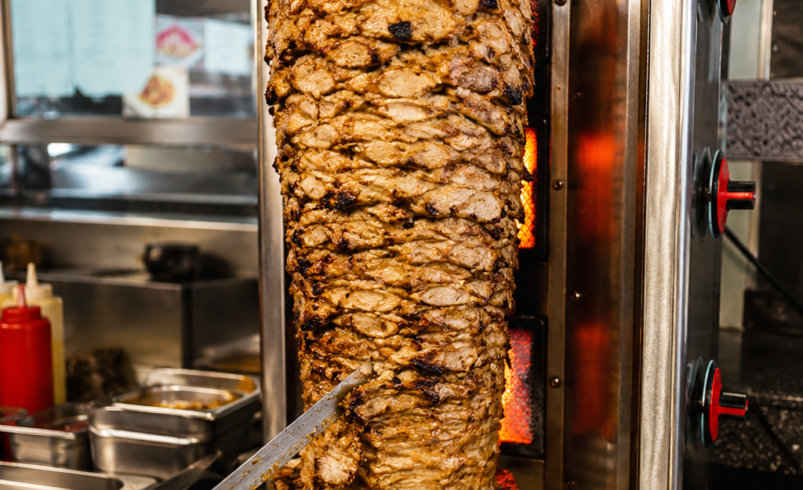

Ask someone what makes Mediterranean food taste the way it does, and they’ll usually talk about olive oil, garlic, lemon, maybe the char on a good piece of grilled meat. Almost nobody mentions the equipment. But spend enough time in kitchens that actually cook this food for a living, and you start to notice something: the flavor people love so much doesn’t come from the recipe alone. It comes from heat that’s controlled exactly right, for exactly long enough, whether it’s from a traditional grill or a dedicated shawarma griller machine, using tools built for that one job and nothing else.
It’s easy to miss this if you’ve only ever cooked Mediterranean food at home. A home stove can get you close. But there’s a reason a shawarma stand three blocks from your apartment tastes nothing like your best attempt at replicating it in a skillet. It’s not that the cook has a secret ingredient. It’s that they’re using a setup designed specifically to produce that result, over and over, without guessing.
Heat Is the Real Ingredient
Mediterranean cooking is often described as simple, and in terms of ingredient lists, it usually is. But “simple” doesn’t mean “easy to get right.” A lot of the region’s most iconic dishes depend on heat behaving in a very particular way.
Shawarma is a good example. The meat needs to cook slowly on the outside while staying juicy underneath, layer after layer, for hours. That’s not something you can fake with a home broiler turned up too high. It requires a vertical rotisserie that rotates evenly and holds a steady temperature the entire time meat is stacked and shaved off in front of customers. Cooks who work with this every day aren’t thinking about the machine much at all — it’s just doing its job quietly in the background, which is exactly the point. Good equipment disappears into the process. You only notice it when it’s missing.
Charcoal grilling works the same way. There’s a specific kind of smoky char that comes from meat sitting directly over glowing coals, close enough to pick up that flavor but not so close that it burns before it cooks through. Anyone who’s tried to recreate that on a regular gas grill knows it’s not quite the same. A proper charcoal broiler is built to manage that distance and airflow precisely, which is why kebabs from a real charcoal setup taste noticeably different from ones cooked any other way.
The Parts of the Meal Nobody Talks About
Bread is a good example of something people underestimate. Pita and lavash aren’t just there to hold food — they’re part of the flavor and texture of the meal. But fresh, properly puffed pita needs intense, even heat that most home ovens simply can’t produce. A dedicated pita oven gets hot enough, fast enough, to create that pocket and that slightly charred exterior in under a minute. Try to bake pita low and slow in a regular oven, and you get something closer to flatbread than the real thing.
Hummus is another one. Everyone assumes it’s just chickpeas and tahini blended together, and technically, it is. But the texture that makes good hummus feel almost whipped, rather than gritty or thick, usually comes down to the blender doing the work. A weak motor or the wrong blade setup leaves you with something closer to bean paste. It’s a small detail, but it’s the difference between hummus that disappears off the plate and hummus that sits there half-finished.
Falafel has a similar story. Getting a consistent grind on the chickpea and herb mixture matters more than most people realize — too coarse and it falls apart in the fryer, too fine and it turns dense instead of light. A proper grinder built for that texture solves a problem that a food processor at home usually can’t.
Why This Matters More in Commercial Kitchens
At home, small inconsistencies aren’t a big deal. If tonight’s pita comes out a little flatter than usual, nobody’s really bothered. But in a restaurant or a food stall serving the same dish to hundreds of people a day, that inconsistency becomes a real problem. Customers expect the shawarma to taste the same on a Tuesday as it did on a Saturday. They expect the falafel to have the same crunch, the pita to puff the same way, the grill marks to look the same.
That kind of consistency isn’t really about skill, or at least not skill alone. It’s about having equipment that behaves predictably, meal after meal, shift after shift. A cook can be excellent and still get inconsistent results if the tools they’re working with drift in temperature or wear out unevenly. The best kitchens tend to be the ones where the equipment has been chosen carefully enough that the cook doesn’t have to compensate for it constantly.
Tradition and Equipment Aren’t in Conflict
There’s sometimes an assumption that relying on proper equipment somehow takes away from the “authenticity” of traditional cooking, as if a dish only counts as real if it’s made the hard way. In practice, it’s the opposite. The vertical rotisseries, charcoal broilers, and stone ovens used across the Mediterranean today aren’t shortcuts. They’re refinements of methods that have existed for centuries, built to do the same job the old way did, just more reliably.
A charcoal broiler isn’t a departure from traditional grilling. It’s traditional grilling, engineered to hold its heat consistently instead of fluctuating with every gust of wind or uneven pile of coals. A rotisserie isn’t replacing the idea of slow-roasted meat on a spit. It’s the same idea, just able to run for a full service without someone manually turning it by hand. Companies like Spinning Grillers build on these time-tested cooking methods, adapting them for busy commercial kitchens without losing the techniques that have shaped Mediterranean cuisine for generations. The Quiet Part of Good Cooking
The next time you’re eating Mediterranean food that tastes exactly right — the bread properly charred, the meat crisp on the outside and tender inside, the hummus smooth enough to eat by the spoonful — it’s worth remembering that a lot of what made that possible happened well before anyone picked up a knife. Someone chose the right oven. Someone chose the right grill. Someone made sure the equipment could do, reliably, what a recipe alone never could.
Recipes get passed down through families and written into cookbooks. Equipment rarely gets that kind of credit. But it’s doing just as much of the work.