


Every household has a version of the same routine. The fridge gets loaded after a grocery run. The week moves fast. Some things get cooked. Some things get forgotten. And by Friday or Saturday, a quiet reckoning happens on the middle shelf: the spinach has gone slimy, the berries have fuzzed over, the leftover pasta from Tuesday has crossed the point of no return, and the half avocado that was going to be lunch three days ago is now brown and hard around the edges.
Everything gets pulled out in one discouraging handful and dropped into the trash. The bag gets heavier. The guilt registers briefly. The cycle resets on the next grocery trip.
This is the fridge cleanout problem, and nearly every household deals with it weekly. The USDA estimates that the average American family of four wastes over $1,500 worth of food per year, and a significant portion of that waste happens in exactly this pattern: bought with good intentions, stored with optimism, discarded with a shrug.
Kitchen composting doesn’t eliminate the fridge cleanout. But it changes what happens to the food that didn’t get eaten, and that shift quietly changes how the whole cycle works.
What the Fridge Cleanout Actually Produces
Most people underestimate how much comes out of the fridge each week because it happens in small, forgettable moments. A yogurt container past its date. A bag of salad greens with liquid pooling at the bottom. Two slices of deli meat that dried out. A lemon that went from firm to soft while sitting in the door shelf.
Individually, none of these feel like waste. Together, they add up to one to three pounds per week in a typical household. That weight goes directly into the trash bag, where it becomes the primary source of kitchen odor, the reason the bag gets heavy before it’s full, and the thing that attracts fruit flies in warm months.
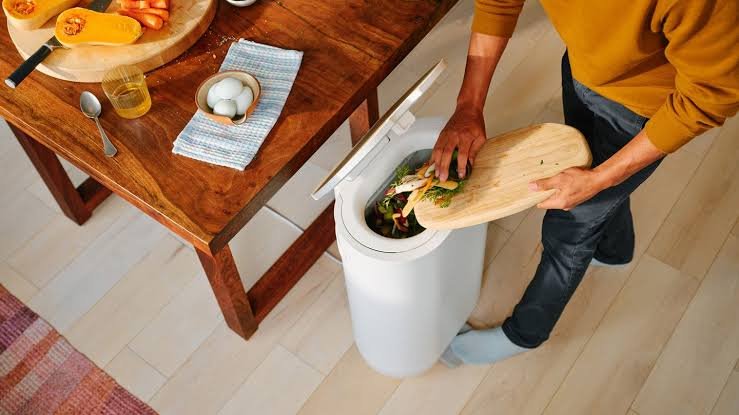
A kitchen compost bin redirects all of it. The expired yogurt, the wilted greens, the leftover rice, the brown avocado. Instead of rotting in a plastic bag destined for a landfill, it gets processed into a dry, stable soil amendment that houseplants and garden beds can use. The trash bag stays lighter, drier, and dramatically less smelly.
Why the Fridge Cleanout Is Actually the Perfect Composting Habit
The irony of the fridge cleanout is that it’s already a routine. It happens every week whether composting exists or not. The food gets pulled, evaluated, and discarded. Composting doesn’t add a new step. It just changes the destination.
And because the cleanout tends to happen all at once, it produces a concentrated batch of compostable material that fills the machine quickly and processes well. Soft, moist foods like wilted produce, expired dairy, and leftover grains break down fast. A fridge cleanout batch often finishes in less time than a mixed cooking-scraps batch because the material is already soft and high in moisture.
For anyone who has been hesitant about composting because it feels like adding another task to the day, the fridge cleanout is the easiest entry point. It’s a chore that already exists, and composting makes it feel productive instead of wasteful.
The Second-Order Effect: Buying Differently
Here’s where it gets interesting. Once the fridge cleanout becomes a composting session instead of a trash moment, the waste becomes visible. When expired food goes into the trash, it disappears. When it goes into a kitchen compost bin,especially one that tracks batch weight, it becomes data.
Week after week, the same items show up: leafy greens bought in bulk that never get finished, fruit that ripens faster than anyone eats it, leftovers cooked in quantities too large for the household. After a few weeks, the grocery list adjusts on its own. The large bag of spinach becomes the small one. The bunch of six bananas becomes three. Small changes, but they add up to real savings
The Habit Flip
The fridge cleanout started as the worst kitchen habit. Food wasted, money lost, guilt absorbed. With a composter on the counter, it becomes something different. The food that didn’t get eaten still produces value. The nutrients go back into soil instead of a landfill. The trash bag stays lighter.
Kitchen composting doesn’t fix overbuying overnight. But it turns the evidence of overbuying into something useful, and that’s enough to start the shift.