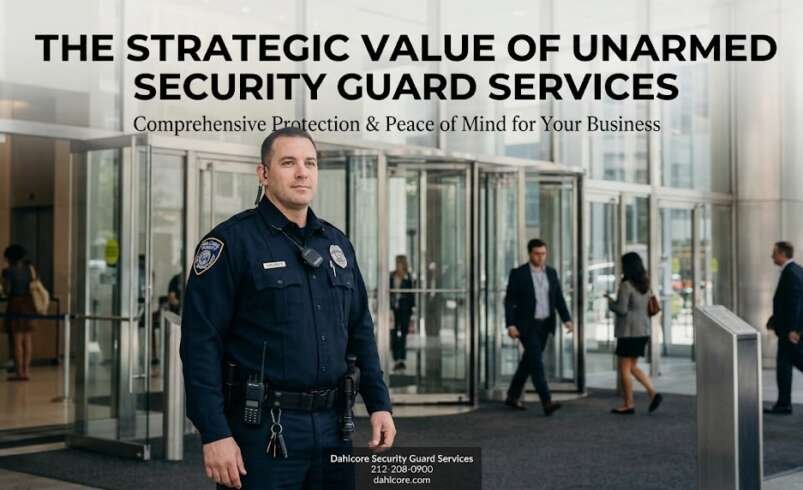

Modern physical security demands a delicate balance between vigilant protection and an open, welcoming environment. While high-threat environments may occasionally require specialized armed details, the vast majority of commercial facilities, residential properties, educational institutions, and corporate campuses thrive best under the watchful eye of unarmed security personnel. Unarmed security guard services deliver an optimal blend of deterrence, access regulation, conflict de-escalation, and professional customer service—safeguarding physical assets while preserving organizational culture.
Understanding how unarmed security officers operate, the tactical training they undergo, and the direct organizational benefits they provide enables property managers and business owners to design an intelligent, cost-effective security posture.
What Are Unarmed Security Guard Services?
Unarmed security guard services deploy trained, licensed security professionals who do not carry lethal firearms. Rather than relying on the threat of lethal force, these officers utilize situational awareness, verbal de-escalation, strict access protocol enforcement, and advanced monitoring systems to neutralize risks before they escalate.
Far from being passive observers, modern unarmed security officers are proactive protectors. They are trained in first aid, emergency response coordination, asset protection, report writing, and customer service. Their primary mandate is crime prevention through active physical presence, systematic perimeter patrols, access point monitoring, and swift protocol execution during emergencies.
Core Responsibilities of Unarmed Security Guards
Professional security officers carry out diverse duties tailored to the specific risk profile of the client facility:
-
Access Control and Visitor Management: Officers verify credentials, manage sign-in logs, issue visitor badges, and inspect incoming deliveries. This ensures that unauthorized individuals cannot access restricted operational areas.
-
Proactive Perimeter and Floor Patrols: By executing irregular, scheduled foot and mobile patrols, officers identify security vulnerabilities such as unlocked doors, malfunctioning alarms, broken perimeter fencing, and suspicious individuals loitering near facilities.
-
Conflict Resolution and De-Escalation: Trained officers recognize escalating tensions—whether between employees, visitors, or trespassers—and intervene using verbal mitigation techniques to defuse hostility peacefully.
-
Emergency Preparedness and Evacuation Oversight: In the event of a fire, medical emergency, power outage, or natural disaster, unarmed officers act as primary marshals who guide occupants through evacuation routes and liaise with local first responders.
-
Incident Documentation and Digital Reporting: Security personnel maintain clear, detailed shift logs and prepare incident reports. These records provide property owners with vital documentation for liability protection, insurance claims, and law enforcement investigations.
Unarmed vs. Armed Security: Strategic Comparison
Selecting between armed and unarmed security requires an honest evaluation of threat levels, legal liabilities, operating budgets, and community dynamics.
| Evaluation Metric | Unarmed Security Guards | Armed Security Guards |
| Primary Focus | Deterrence, customer service, access management, de-escalation | Threat neutralization, high-value asset protection, active lethal deterrence |
| Ideal Environment | Corporate offices, retail centers, schools, residential complexes, clinics | Banks, armored transport, critical infrastructure, high-threat zones |
| Liability Exposure | Significantly lower insurance premiums and operational liability | Higher insurance costs and legal liability due to lethal force capacity |
| Visitor Perception | Approachable, reassuring, and community-friendly | Intimidating or high-stress in everyday consumer settings |
| Cost Efficiency | Highly scalable and cost-effective for daily facility coverage | Substantially higher hourly billing rates due to training and licensing |
For most public-facing businesses and residential communities, armed personnel can inadvertently introduce an atmosphere of tension or unease. Unarmed guards provide visible security while keeping clients, staff, and residents at ease.
Key Industries That Rely on Unarmed Protection
The versatility of unarmed security teams makes them indispensable across multiple commercial and public sectors:
1. Commercial Real Estate and Corporate Campuses
Corporate lobbies demand security personnel who reflect the organization’s executive brand. Unarmed guards monitor entry points, handle deliveries, escort personnel after hours, and manage digital badge access while offering a polished front-desk presence.
2. Retail Centers and Supermarkets
Retail theft and organized retail crime cause billions in inventory loss annually. Unarmed guards monitor high-shrinkage zones, act as visible visual deterrents against shoplifting, and assist retail staff with disorderly patrons.
3. Healthcare Facilities and Clinics
Hospitals, urgent care centers, and outpatient clinics experience emotionally charged situations daily. Unarmed guards maintain order in emergency waiting rooms, prevent unauthorized access to pharmacies, and protect medical personnel without escalating volatile patient encounters.
4. Residential and Gated Communities
Homeowners and tenants prioritize privacy and community safety. Unarmed officers staff guard gates, monitor surveillance cameras, verify visitor authenticity, and patrol neighborhoods at night, cultivating safe living environments without altering the neighborhood’s residential character.
5. Construction Sites and Logistics Hubs
After operational hours, construction sites and warehouses face risks of equipment theft, copper scavenging, and vandalism. Mobile unarmed security guards patrol site perimeters, inspect entry barriers, and safeguard valuable raw materials.
The Strategic Advantage: Why Unarmed Security Works
1. Proactive Conflict De-Escalation
Modern unarmed guards are versed in behavioral detection and crisis intervention. Rather than escalating conflicts through confrontation, trained professionals identify agitation early, maintain calm body language, and employ verbal techniques that guide disputing parties toward safe resolutions.
2. Enhanced Customer Experience
In many commercial buildings, the security officer is the very first person a visitor encounters. Unarmed personnel act as brand ambassadors—giving directions, answering basic facility questions, opening doors, and aiding individuals with mobility limitations.
3. Lower Operational Costs and Insurance Premiums
Carrying firearms elevates an enterprise’s liability profile. Insurance carriers often charge significantly higher underwriting rates to businesses that employ armed security details. Choosing qualified unarmed personnel keeps coverage costs manageable while lowering the risk of catastrophic weapon-related incidents.
4. Seamless Technology Integration
Modern security officers work hand-in-hand with technology. They operate electronic visitor management systems, review closed-circuit television (CCTV) feeds, handle access badge encoding, and log incidents on digital patrol management software in real time.
Choosing a Trusted Provider
Securing physical premises requires a security partner with proven operational standards, rigorous employee vetting, and deep regulatory compliance.
Dahlcore Security Guard Services delivers dependable, tailored security guard solutions for commercial, residential, and corporate facilities. Every officer undergoes extensive background screenings, site-specific protocol onboarding, emergency response drills, and customer-facing communication training.
Whether an organization requires ongoing front-desk concierge security, mobile perimeter surveillance, or temporary coverage for high-attendance corporate events, Dahlcore builds proactive protection strategies designed around specific operational needs.
Frequently Asked Questions (FAQs)
Are unarmed security guards legally permitted to detain individuals?
Unarmed security officers generally operate under citizen’s arrest laws and property owner rights. If an officer witnesses an individual committing a felony, trespassing unlawfully, or endangering others, they are legally permitted to detain the individual using reasonable, non-lethal physical restraint while awaiting law enforcement arrival.
What equipment do unarmed security officers carry?
While unarmed guards do not carry firearms, they often carry non-lethal defensive and communication tools based on facility authorization. Standard equipment includes two-way radios, mobile logging devices, flashlights, first-aid kits, and, where certified, body cameras, personal alarms, or pepper spray.
How are unarmed security guards trained?
Professional guards complete state-mandated licensing curriculums covering security law, emergency protocols, ethics, report writing, and observation techniques. Reputable agencies supplement this with specialized instruction in customer service, dispute resolution, CPR/AED administration, and digital surveillance operations.
Can unarmed guards manage large crowd events?
Yes. Unarmed security officers are routinely deployed to manage crowd flow, check tickets or wristbands, secure backstage or restricted corridors, and enforce venue rules at conferences, corporate summits, and private gatherings.
How does an organization determine how many guards are needed?
Determining guard ratios depends on square footage, ingress and egress counts, operating hours, local crime statistics, and total daily visitor volume. A comprehensive on-site risk assessment from a professional firm establishes whether a single concierge officer or a multi-guard patrol detail is needed.
Strengthening Your Organization’s Security Posture
Physical safety is a cornerstone of business success, tenant retention, and operational productivity. Implementing unarmed security guard services strikes an ideal balance between strict defense and welcoming hospitality. By deploying licensed, attentive professionals, organizations preserve peace of mind, safeguard physical assets, and create an atmosphere where employees, clients, and residents can interact with confidence. Collaborating with an experienced security partner ensures that protection protocols remain resilient, compliant, and ready for any challenge.