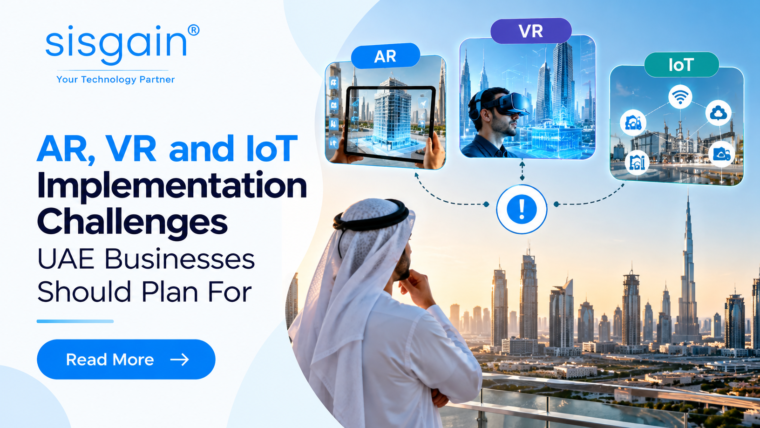

Businesses across the UAE are exploring immersive experiences, connected devices, and digital tools to improve how they manage operations, train employees, maintain assets, and serve customers. Yet adopting these technologies involves more than choosing suitable hardware or building an application. AR VR IoT implementation challenges can affect project costs, system reliability, employee adoption, cybersecurity, and the ability to demonstrate measurable business value.
Augmented reality (AR) adds digital information to a view of the physical world, virtual reality (VR) creates immersive digital environments, and the Internet of Things (IoT) connects devices that collect and exchange data. Each technology has different technical requirements, but challenges become more complex when organisations integrate them into existing business systems.
For UAE businesses, successful implementation requires careful planning around infrastructure, data protection, integration, staff readiness, project scope, and long-term support. These considerations are particularly important for organisations operating across multiple sites, managing connected equipment, or introducing immersive applications into established workflows.
This guide explores the major implementation challenges, explains why they arise, and outlines practical ways to reduce risk before investing in AR, VR, or IoT solutions.
Understanding AR, VR and IoT Before Planning Implementation
Before evaluating implementation risks, businesses need to understand what each technology does and why its requirements differ.
Augmented reality
AR overlays digital information—such as labels, instructions, diagrams, or 3D models—onto a view of the real environment. It may run on a smartphone, tablet, or compatible smart glasses.
A maintenance employee, for example, could use an AR application to view relevant equipment information while inspecting a physical machine. The application may need camera access, accurate asset identification, suitable tracking, and integration with maintenance records.
The challenge is not simply displaying digital content. The information must be accurate, positioned appropriately, easy to understand, and practical to use in the actual working environment.
Virtual reality
VR places users inside a simulated digital environment, usually through a headset and associated input devices. Businesses may use it for employee training, product demonstrations, design reviews, and virtual walkthroughs.
A VR training application may require a realistic digital environment, carefully designed interactions, compatible hardware, and a method of assessing whether users have learned the intended skills.
A visually impressive simulation is not necessarily an effective training solution. Its value depends on whether it supports the relevant task and produces useful learning outcomes.
Internet of Things
IoT connects sensors, equipment, trackers, and other devices to systems that collect and process data. These systems can support asset monitoring, equipment management, environmental tracking, and operational reporting.
A business might use connected sensors to monitor temperature or equipment performance. To make the information useful, the deployment needs reliable devices, appropriate connectivity, dependable data processing, and a plan for responding to the information collected.
IoT systems also introduce responsibilities around device authentication, updates, network access, data storage, and ongoing maintenance.
Why the distinctions matter
The phrase augmented reality vs virtual reality explained highlights a useful planning principle: AR and VR are not interchangeable, and neither performs the same role as IoT.
AR supports interaction with the real world, VR supports immersive interaction with a simulated environment, and IoT supports connected data collection. Businesses that understand these differences can avoid selecting a technology that does not match their actual operational problem.
When multiple technologies are combined, teams must account for the requirements of each component as well as the connections between them.
Integration With Existing Business Systems
One of the most common enterprise challenges is connecting a new solution to the software and processes already used by the organisation.
Businesses may rely on enterprise resource planning systems, customer relationship management platforms, warehouse management applications, maintenance software, learning platforms, and reporting tools. A new AR, VR, or IoT application may need to exchange information with one or more of these systems.
For example, an AR maintenance application may need to retrieve equipment details from an asset management platform while receiving selected readings from an IoT system. If asset identifiers differ across platforms, the application may display information for the wrong machine or fail to retrieve the relevant record.
VR projects can face different integration problems. Training environments may need to connect with learning systems, employee accounts, or training records. If the application operates separately from established processes, administrators may need to manage duplicate information.
How businesses can reduce integration problems
- Map the existing systems and data sources before development.
- Identify which platform owns each important record.
- Define how systems exchange data and handle errors.
- Test integrations with realistic data and user permissions.
- Establish responsibility for updates, support, and future changes.
Integration should be included in the original project scope rather than treated as a minor task after the application has been developed.
Cybersecurity and Connected Device Security
Connected devices can introduce additional entry points into an organisation’s technology environment. Sensors, gateways, mobile devices, headsets, cloud platforms, and APIs may all need to communicate securely. If one component is poorly configured, it can expose information or create opportunities for unauthorised access.
These connected device security challenges are especially important when IoT systems connect to business-critical equipment or when AR applications display operational information that should only be available to authorised employees.
Security concerns may include weak device credentials, outdated firmware, excessive user permissions, unencrypted data transfers, and insufficient monitoring. VR applications can also process user accounts, training records, voice data, or other information that needs appropriate protection.
Practical security measures
Businesses should establish security requirements before selecting devices or platforms. These should cover device identity, authentication, access permissions, software updates, data transmission, logging, and incident response.
Each device and application should have access only to the information and systems it needs. Organisations should also establish a process for removing lost or retired devices from the environment and responding to suspected security incidents.
Security testing should cover the complete solution, not just the AR or VR application. A secure interface cannot compensate for an insecure sensor, poorly configured network, or vulnerable integration.
IoT Deployment Challenges in the UAE
The IoT deployment challenges in UAE businesses encounter depend on their sector, location, facilities, and operational requirements. A connected system designed for a controlled office environment may not work equally well in a warehouse, industrial facility, outdoor site, or building with difficult network coverage.
Connectivity is one consideration. Sensors may need to transmit data through Wi-Fi, cellular networks, gateways, or other communication methods. Businesses must confirm that the selected approach provides sufficient coverage, capacity, reliability, and power efficiency for the intended application.
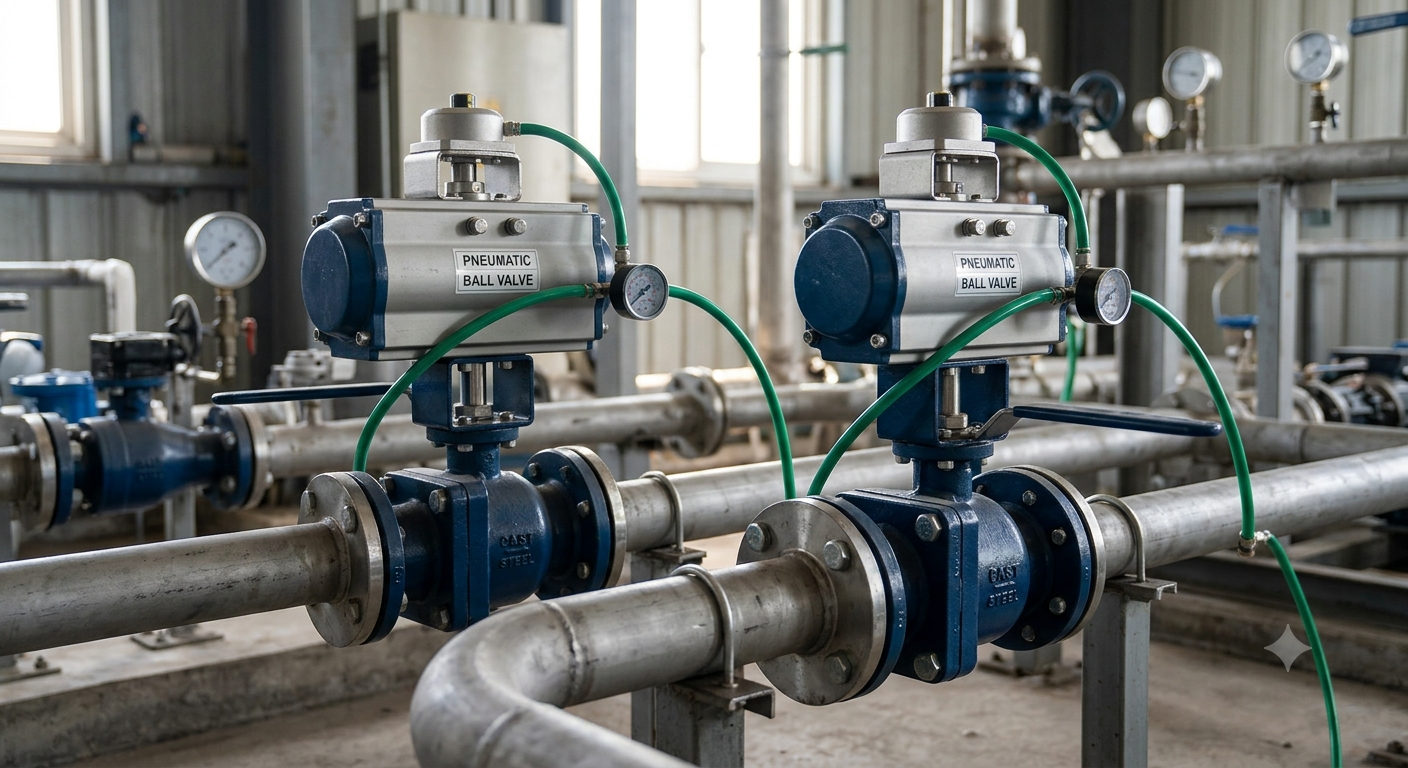
Physical conditions also matter. Devices used outdoors or in industrial environments may require suitable enclosures, installation methods, and maintenance schedules. Temperature, dust, vibration, moisture, and other conditions should be assessed against the device’s specifications.
Data handling is another important consideration. Organisations should determine where data is processed and stored, who can access it, how long it is retained, and which contractual or regulatory obligations apply. Requirements can vary by industry and use case, so businesses should confirm the rules relevant to their particular deployment rather than rely on assumptions.
Planning for local operating conditions
Before deployment, conduct a site assessment and test devices in the actual environment. Check signal coverage, gateway placement, power availability, device installation, and the process for replacing or updating equipment.
Where an organisation operates across several UAE locations, avoid assuming that one installation design will work everywhere. A controlled pilot can help reveal differences in connectivity and operating conditions before the rollout expands.
Infrastructure and Device Compatibility
AR and VR applications may require devices with suitable processing power, displays, sensors, cameras, tracking capabilities, and battery life. IoT systems require compatible sensors, networks, gateways, and software platforms. The combined solution must work reliably across these components.
A VR application may run well on one headset but perform poorly on another. An AR interface may depend on a camera or tracking feature that is unavailable on an older mobile device. An IoT sensor may use a communication protocol that the selected platform does not support directly.
These differences can affect project cost and the number of devices an organisation can support.
How to manage compatibility
First, define the devices employees are expected to use and identify any minimum technical requirements. Test the application on the intended hardware rather than relying solely on a developer’s workstation or a demonstration device.
For IoT, confirm the compatibility of sensors, communication protocols, gateways, and the data platform. For AR and VR, test application performance, tracking, visual clarity, comfort, and interaction methods.
Businesses should also plan for device replacement. A solution that depends on one specific model may become expensive to maintain if that device is discontinued or no longer supported.
Data Quality and Real-Time Performance
AR interfaces and IoT dashboards can only support sound decisions when the underlying information is reliable. Sensor readings may be inaccurate, data may arrive late, and software platforms may associate a reading with the wrong asset.
These problems become more significant when users interpret the information while performing a physical task. If an AR application displays an outdated equipment reading without indicating its age, an employee may mistakenly assume that the reading is current.
Define data requirements early
Identify which information is essential, how frequently it needs to be updated, and what level of accuracy is required for the intended task. The appropriate requirements for a non-critical building comfort display may differ from those for a time-sensitive industrial monitoring application.
The solution should detect missing or unexpected data where practical, display timestamps when relevant, and communicate when the connection is unavailable. Critical decisions should follow established verification procedures rather than rely on an unconfirmed visual indicator.
Businesses should test the full data path—from sensor collection through processing to the final interface—to identify where delays or errors may occur.
Employee Adoption, Training and Usability
Even a technically successful solution can fail to deliver value if employees find it confusing, uncomfortable, or disruptive. This is one of the major AR VR implementation challenges for enterprises, particularly when introducing new devices into established workflows.
AR applications may be difficult to use if labels obstruct the user’s view, controls are awkward, or instructions require too much attention. VR applications can create discomfort for some users or require more time to learn than expected. IoT platforms can also overwhelm employees with alerts and information that do not help them perform their tasks.
Involve employees before rollout
Include representative users in the design and testing process. Ask them to complete realistic tasks with the proposed solution, then observe where they need help or make mistakes.
Provide training that reflects the actual workflow. Employees should understand how to use the application, what the displayed information means, and what to do if the system fails or produces uncertain information.
Organisations should also provide an alternative process for situations in which a device is unavailable, a user cannot comfortably use the equipment, or connectivity is interrupted.
Adoption is more likely when employees understand why the solution is being introduced and can see how it supports their work.
Budget, Project Scope and Return on Investment
AR, VR, and IoT projects can require more investment than businesses initially expect. The total cost may include hardware, software development, 3D modelling, sensors, connectivity, integration, cybersecurity testing, training, content updates, support, and device replacement.
A prototype may demonstrate that an idea is technically possible without proving that it is affordable to operate at scale. Costs can increase when a project expands to more locations, supports additional device types, or needs to integrate with legacy systems.
Build a realistic business case
Before approving a project, separate initial costs from recurring expenses. Identify the expected operational benefit and define how it will be measured.
For example, a maintenance project might aim to reduce the time employees spend finding equipment information. A VR training project might aim to improve performance on a defined assessment. An IoT deployment might aim to increase visibility into equipment conditions.
Use baseline measurements to evaluate whether the proposed solution is likely to justify its cost. Avoid presenting estimated savings as guaranteed outcomes, and include the costs of training, support, and future updates.
A limited pilot can help validate the business case before the organisation commits to a larger rollout.
Planning an Enterprise Immersive Technology Project
Planning an enterprise immersive technology project requires coordination between business owners, IT teams, security specialists, operational employees, and development partners. Without clear ownership, even a promising application can face delays, unclear requirements, and disagreements about responsibility.
Start by identifying the business problem and the users who experience it. Define the expected outcome, the information the application must display or collect, and the systems it needs to connect with.
Next, establish the project scope. Decide whether the first phase requires AR, VR, IoT, or a combination. Document the assumptions, dependencies, technical requirements, security expectations, and acceptance criteria.
A practical implementation sequence
Discovery and feasibility: Review the current process, interview stakeholders, identify relevant data sources, and evaluate whether the technology fits the use case.
Solution design: Define the architecture, user experience, integration requirements, device choices, data flows, and security controls.
Pilot development: Build a limited solution for a specific workflow, location, or group of users.
Testing and validation: Check technical reliability, usability, security, data quality, and compatibility under realistic conditions.
Rollout and support: Expand only after reviewing the pilot results. Establish support responsibilities, device management procedures, training resources, and a process for future updates.
This staged approach helps organisations identify problems early and reduces the risk of building a large system before confirming that it meets user needs.
Understanding AR VR IoT Integration Risks
AR VR IoT integration risks extend beyond individual device or application failures. When several technologies work together, a problem in one component can affect the wider process.
For example, an IoT sensor might send inaccurate data, the platform could associate it with the wrong asset, and an AR application could display it beside a different machine. Each component might appear to function normally while the complete workflow produces misleading information.
Other risks include inconsistent device identities, delays between systems, different access permissions, unsupported software updates, and unclear responsibility when an integrated process fails.
Reduce risk across the complete system
Map how information travels from the physical device to the final application. Identify which system owns the data, how its accuracy is checked, and what happens if a connection or component fails.
Test scenarios such as lost connectivity, stale readings, device replacement, incorrect asset identification, and unauthorised access. Establish a clear way for employees to recognise problems and follow an approved fallback process.
Businesses should also assign responsibility for monitoring and maintaining the complete solution. A system that works during launch but lacks ongoing ownership may become less reliable as devices, software, and operating requirements change.
Choosing AR, VR or IoT for the Right Business Problem
Choosing AR VR or IoT technology should begin with the task the business wants to improve—not with the features of a particular device or platform.
AR may suit situations in which employees need digital guidance while interacting with physical equipment or locations. VR may suit immersive training, simulated environments, or design reviews. IoT may suit monitoring, asset tracking, and collecting data from connected devices.
A business should consider combining technologies only when their roles complement each other. For example, IoT might identify a machine condition, AR might display the relevant information to a technician, and VR might provide a simulation for training the technician to follow the correct procedure.
Not every project needs all three technologies. If the primary requirement is to monitor equipment remotely, an IoT platform and conventional dashboard may be enough. If employees need a visual instruction guide, an AR application may deliver value without an immersive VR environment.
Questions to ask before selecting a solution
- What specific operational problem needs to be addressed?
- Which information or interaction is missing from the current process?
- Who will use the solution, and in what environment?
- Can existing software or hardware meet the requirement?
- What security, integration, and maintenance responsibilities will arise?
- How will the organisation measure success?
Answering these questions helps businesses select an appropriate level of technology and avoid unnecessary complexity.
Enterprise AR VR IoT Applications Across Business Operations
Enterprise AR VR IoT applications can help organisations connect real-time operational data with immersive visualisation, employee training, and on-site workflows. For example, IoT sensors can monitor industrial equipment, AR can display relevant equipment status to maintenance teams, and VR can provide a simulated environment for practising maintenance procedures. UAE businesses should evaluate these applications according to their operational needs, integration requirements, security risks, and expected business outcomes before investing in a full-scale implementation.
Selecting a Development Partner in the UAE
Choosing a suitable development partner can help businesses identify technical limitations, plan integrations, and create a solution that fits their operational requirements. However, a provider’s marketing claims should not replace a structured evaluation of its capabilities.
When assessing providers offering iot development services, ask about device integration, data architecture, connectivity, platform security, monitoring, and post-launch maintenance. The team should be able to explain how the proposed system will handle missing data, device failures, and future changes.
For immersive applications, ask potential partners how they approach interaction design, device compatibility, testing, content creation, and user training. A partner should understand the intended workflow rather than focus only on visual presentation.
Evaluate VR and AR providers carefully
Businesses researching vr company dubai options should clarify whether a provider offers custom VR development, ready-made experiences, training simulations, equipment rental, or a combination of services. These offerings meet different needs and should not be treated as interchangeable.
Similarly, businesses exploring augmented reality dubai solutions should assess whether a prospective team can connect AR interfaces with the required business data and existing software. A visually impressive AR demonstration may not be sufficient if the real project requires accurate asset identification, secure data access, and dependable integration.
Some organisations may also consider vr cloud solutions in dubai when they need to distribute or manage virtual experiences through cloud-based infrastructure. Before selecting this approach, evaluate network performance, data handling, device compatibility, access controls, and recurring costs. Cloud delivery may simplify certain aspects of management, but it does not automatically eliminate connectivity or security challenges.
The best partner is one that explains trade-offs clearly, defines the project scope, documents dependencies, and provides a realistic plan for testing and long-term support.
A Practical Readiness Checklist for UAE Businesses
Before beginning a deployment, decision-makers can use the following checklist to identify gaps in planning.
- The business problem and expected outcome are clearly defined.
- The selected technology matches the task and intended users.
- Existing software, data sources, and devices have been assessed.
- Connectivity and physical operating conditions have been tested.
- Data ownership, access permissions, privacy, and security responsibilities are documented.
- Employees have participated in usability testing and planning.
- The project budget includes integration, training, support, and maintenance.
- Success measures and baseline performance have been established.
- The pilot includes realistic failure scenarios and a fallback process.
- Ownership for ongoing monitoring, updates, and support is assigned.
Completing this checklist does not guarantee success, but it helps teams identify unanswered questions before they become expensive problems. For complex projects, businesses may also need input from relevant legal, compliance, cybersecurity, and technical specialists.
How SISGAIN Technologies Can Support Enterprise Technology Planning
SISGAIN Technologies works in the software development and IT solutions space, supporting organisations that want to align technology with their business objectives. For businesses considering AR, VR, or IoT, a structured approach begins with understanding operational requirements, assessing existing systems, and identifying the most appropriate implementation strategy. Project planning should account for integration, security, user experience, testing, and ongoing maintenance from the outset. Organisations can start with a defined use case, establish measurable goals, and evaluate the results of a pilot before expanding the solution. Careful planning helps decision-makers understand technical dependencies and make informed choices about the scope and long-term direction of their technology investment.
Conclusion
AR, VR, and IoT can support valuable business applications, but successful implementation requires more than selecting the right technology. Integration complexity, cybersecurity, infrastructure readiness, data quality, employee adoption, and ongoing costs can all influence project outcomes.
UAE businesses can reduce uncertainty by defining their operational goals, assessing their existing systems, involving employees, and testing a focused solution before scaling. They should also establish clear responsibilities for security, maintenance, data management, and future updates.
The most effective approach is to select technology according to the problem it needs to solve, validate the solution under realistic conditions, and measure its results against a baseline. With practical planning and continuous evaluation, organisations can make better-informed investment decisions and build technology solutions that support real business needs.
Frequently Asked Questions
1. What are the biggest AR VR IoT implementation challenges?
The main challenges include integration with existing systems, cybersecurity, device compatibility, infrastructure readiness, data accuracy, employee adoption, and total cost of ownership. The relative importance of each challenge depends on the use case and the operating environment.
2. Why are AR VR implementation challenges for enterprises different from those of small projects?
Enterprise projects often involve multiple departments, legacy applications, different user groups, complex permissions, and larger device deployments. These dependencies increase the need for coordination, integration testing, governance, and long-term support.
3. What should UAE businesses know about IoT deployment challenges?
Businesses should evaluate network coverage, sensor suitability, device management, data handling, physical operating conditions, and applicable requirements. Testing the proposed devices and connectivity in the actual deployment environment can reveal issues before a wider rollout.
4. How can companies reduce connected device security risks?
Organisations should use appropriate device authentication, access controls, secure data transmission, software updates, monitoring, and incident-response procedures. Security assessments should cover devices, networks, applications, and integrations as parts of one system.
5. Should a business implement AR, VR, and IoT at the same time?
Not necessarily. Businesses should begin with the technology that best addresses their immediate operational problem. Additional technologies should be introduced only when they provide a clear, measurable benefit and can be integrated reliably.
6. How can a business measure the success of an AR, VR, or IoT project?
Choose measurable indicators before the pilot begins. Depending on the use case, these could include task completion time, error rates, training assessment results, equipment downtime, data availability, employee adoption, and total operating costs. Compare the results with the original baseline before expanding the project.