
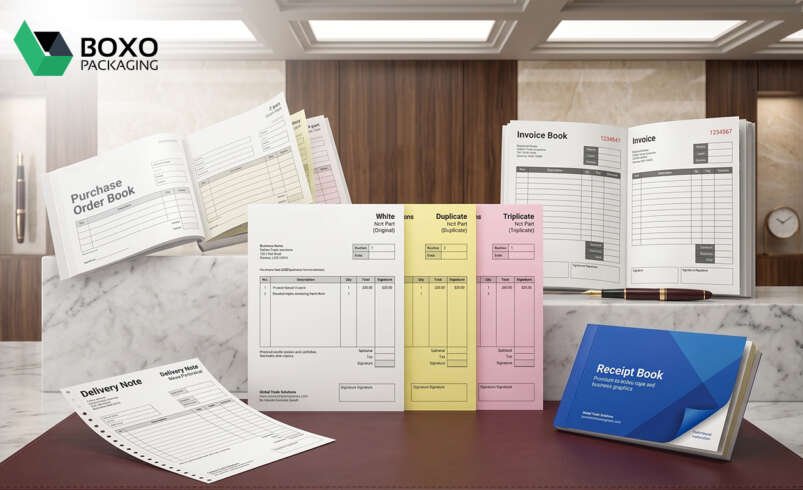

Some business tools never fully disappear, they just quietly keep doing their job while everyone assumes technology replaced them. Carbonless forms fall squarely into that category, still producing duplicate paperwork the moment a pen touches the page, no printer or app required.
What Actually Happens Inside a Carbonless Form When You Write on It?
Carbonless forms work through a chemical reaction between two coatings, not a physical carbon sheet, which is the entire reason the format still exists decades later.
The mechanism itself is genuinely clever. The back of the top sheet carries microscopic capsules containing a colorless dye, and the sheet underneath has a reactive clay coating on its front, according to Koehler Paper. Writing pressure bursts those capsules, releasing the dye onto the reactive layer below, which is exactly how carbonless forms produce a clean duplicate without a single smudge of actual carbon.
A supplier like Boxo Packaging typically fields questions from business clients who assume this technology is older or messier than it actually is. Here’s what tends to keep carbonless forms in active use.
- No carbon sheet to insert, remove, or accidentally smudge across a desk
- Multiple copies generated instantly, useful for receipts, work orders, and delivery slips
- A physical, signed record that some industries still require for compliance
- Compatibility with both handwriting and standard impact printers
How Big Is the Market for Carbonless Forms Today?
Demand for carbonless documentation has held remarkably steady given how much paperwork has shifted online over the past decade.
The global carbonless papers market was valued at roughly $1.82 billion in 2025 and is projected to reach $2.17 billion by 2032, growing at a 2.8% compound annual rate, according to 24chemicalresearch. That slower but consistent growth shows carbonless forms aren’t disappearing, just settling into a smaller but steady role in daily operations.
Carbonless Forms and Business Invoicing
Invoicing remains one of the most common uses for carbonless documentation, particularly among businesses that deal with vendors or clients who still expect a physical paper trail.
NCR paper served as the preferred medium for roughly 52% of business to business invoices in 2024, according to market research from MarketGrowthReports, showing that carbonless forms still handle a meaningful share of commercial paperwork despite widespread digital invoicing tools.
Carbonless Forms and Regulated Industries
Regulated sectors continue to favor carbonless documentation specifically because physical paper trails are still treated as more tamper resistant than digital logs under certain compliance standards.
Roughly 29% of banks and financial institutions continue to rely on NCR paper for secure, tamper evident documentation, according to MarketGrowthReports research, keeping carbonless forms in steady use across sectors where digital records alone aren’t considered sufficient.
Carbonless Forms and Common Ply Formats
Format choice affects both cost and usability, and one specific configuration has become the default for general business use.
The two part NCR paper segment held roughly 34.3% of the carbonless paper market by paper type in 2024, according to Future Market Insights, making it the standard choice for receipts, work orders, and simple carbonless forms that only need a single duplicate copy.
Paperwork solves one kind of everyday business problem, but plenty of businesses face a completely physical version of the same idea, handing something directly to a customer without any digital step involved at all. Gable packaging answers that need on the retail side.
What Makes Gable Packaging a Practical Choice, Not Just a Design Preference?
Gable packaging refers to foldable cartons with a built in handle, shaped like a small house or barn roof, designed to be carried without a separate bag.
That handle solves a genuine logistics problem for retailers. Gable packaging eliminates the need for a separate carrier bag entirely, which matters even more now that packaging regulation has shifted in several states.
Are Plastic Bag Bans Actually Increasing Demand for Gable Packaging?
Regulation has quietly become one of the biggest practical drivers behind handle equipped packaging, not just a branding trend on its own.
As of January 2026, twelve U.S. states have enacted statewide bans on single use plastic bags, according to Earth911. Retailers in those states either charge a fee for paper bags or eliminate bags altogether, making a self-carrying format like gable packaging a genuine operational workaround rather than just an aesthetic upgrade.
Gable Packaging and Customer Retention
Damage and mishandling are rare with gable packaging, since it’s typically handed directly to a customer rather than shipped through a carrier network full of conveyor belts and delivery trucks.
A Shorr Packaging survey found that 73% of consumers are less likely to buy from a brand again if their order arrives damaged, a risk that gable packaging largely avoids by design, given how rarely it travels through rough carrier handling.
Gable Packaging in the Food Service Industry
Food service remains the heaviest daily user of gable packaging, mainly because the category keeps expanding at a steady, predictable pace.
The global food service packaging market is projected to grow from $139.75 billion in 2026 to $171.06 billion by 2031, at a 4.13% compound annual rate, according to Mordor Intelligence, and gable packaging sits squarely inside that growth as a go to format for bakeries and quick service counters.
Gable Packaging and Bakery Demand Specifically
Bakery products drive a disproportionate share of gable packaging demand, since the shape naturally suits pastries, cupcakes, and small baked goods.
The bakery and confectionery segment holds roughly 38.82% share of the broader food packaging market in 2026, according to Fortune Business Insights, reinforcing why gable packaging remains a default order for bakeries rather than a niche choice.
Both categories quietly keep doing their job long after most people assume something more modern replaced them. Carbonless forms still generate physical duplicates the instant a pen touches paper, while gable packaging still handles the in person handoff moment better than almost any digital alternative could. A supplier like Boxo Packaging can usually help a business figure out where either format still earns its keep in day to day operations.