
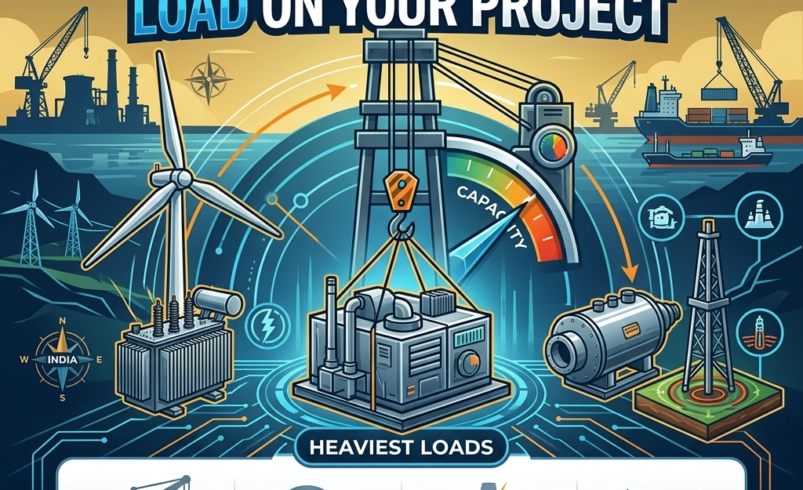

Energy projects rarely fail because a truck was unavailable. They slip because a transformer arrived before the foundation was ready, a route survey missed a weak bridge, or a permit for an oversized load came through two weeks late. When you assess energy logistics companies in India, the most reliable method is to take the heaviest, most awkward item on your project and ask each provider how it would move it from factory gate to installation point. The answers reveal far more than a fleet list.
Why energy cargo is a different problem
Power, oil and gas, and renewable projects move equipment that is heavy, long, high-value, and often one-of-a-kind: turbine components, transformers, boilers, pressure vessels, transmission towers, solar modules in large volumes, and wind blades that can run to many metres in length. Many of these items cannot be replaced quickly if damaged, and the project schedule often depends on a single delivery date.
The cargo also travels to places built for neither size nor weight: remote plant sites, hilly terrain, desert stretches, and coastal ports. A provider’s skill with oversized, project-critical cargo matters more than its general trucking capacity, because the failure points are specific to this kind of freight.
Start with the route, not the vehicle
Before any vehicle is assigned, a competent provider surveys the route. That means checking bridges for load limits, measuring clearances under overhead lines and structures, identifying tight turns, and confirming whether roads can bear the weight of the loaded vehicle.
Ask each provider how it runs route surveys, who signs them off, and what happens when the survey finds an obstacle. Solutions may include temporary road reinforcement, utility line lifting, or a change of route, and each needs lead time. Insist on seeing a route survey format before award, since an undocumented route is a risk carried by you.
Permits, escorts, and movement windows
Oversized loads usually need approvals from road authorities, and sometimes police escorts or restricted travel windows. Timelines vary by state and by cargo dimensions, and a missed approval can hold a convoy for days.
Ask who applies for permits, how far in advance, and how the provider tracks approvals across states on a multi-state route. For long journeys, ask how handovers between states are managed and who is accountable at each stage. Your own compliance team should confirm the permits that apply to your cargo.
Equipment and handling capability
Different loads need different equipment: multi-axle trailers, hydraulic platforms, specialised carriers for long blades, cranes for loading and unloading, and lashing methods that secure heavy cargo safely.
Ask what equipment the provider owns, what it hires, and how it decides which to use. Check who supervises loading and securing, and whether the lifting and lashing plans are prepared by qualified people. If part of the work is subcontracted, ask who bears responsibility for the cargo at each stage.
Safety systems you can verify
Heavy movements carry real risk to people and property, so safety should be demonstrable. Look for written procedures, trained operators, pre-trip checks, incident reporting, and a process for reviewing near-misses. Many energy clients also set their own site safety requirements, which a provider must be able to follow.
Ask for the safety record in a form you can verify, how incidents are reported to you, and what induction drivers and crews receive before entering your site. A provider that welcomes an audit of its practices usually has less to hide.
Sequencing deliveries to the construction schedule
Delivery is only useful when the site can receive it. Equipment that arrives early needs storage and protection, while late equipment idles crews and equipment. Good project cargo logistics links dispatch dates to the site’s installation sequence, not just to the manufacturer’s readiness.
Ask how the provider plans staging, where cargo waits if the site is not ready, and how it handles storage of sensitive items such as electrical equipment and instruments. Monsoon and extreme heat both affect scheduling and storage, so ask how weather risk is built into the plan.
Documentation, traceability, and visibility
Energy projects involve large volumes of paperwork: packing lists, delivery challans, inspection records, and in many cases customs documents for imported equipment. Missing or mismatched documents can stop cargo at a checkpoint or at the site gate.
Ask how consignments are tracked, how often you receive updates, and how exceptions are escalated. For imported components, ask who handles clearance and how the handover from port to site is coordinated.
Choosing between a specialist and an integrated partner
Some firms specialise in heavy-lift and oversized cargo. Others offer a wider supply chain that includes warehousing, general freight, and distribution. A project often needs both: heavy movements for major equipment, and regular logistics for consumables, spares, and site materials.
AWL India is an integrated 3PL covering transportation, warehousing, and project logistics among its services, which can reduce handoffs between the heavy movement and the wider supply flow. Test any provider, including AWL, against the specific cargo and route on your project.
A practical way to shortlist
- List your heaviest and longest items, their dimensions, weights, and delivery dates.
- Send each provider the same brief, including origin, destination, and site constraints.
- Request a sample route survey, a movement plan, and a safety plan for one item.
- Ask for references on similar cargo, and verify them directly.
- Review the contract for liability, insurance, delay terms, and subcontracting.
The provider that asks careful questions about your site before quoting has usually moved similar cargo before. That habit is a better guide than any claim about fleet size.