
Security incidents do not always begin with an obvious threat. Sometimes, prolonged presence near restricted entrances, unusual movement around sensitive locations, or repeated activity in specific areas can indicate a situation that requires attention. AI suspicious activity detection helps organisations identify such patterns through computer vision and intelligent video analytics. By analysing compatible CCTV feeds, AI-powered systems can identify configured activities, generate alerts, and help security teams investigate potential risks before situations escalate.
Traditional surveillance often depends on security personnel continuously observing multiple camera feeds. However, this becomes challenging across large facilities, warehouses, commercial buildings, and public spaces. AI-based detection adds another layer of security by automatically identifying activities that match predefined conditions.
Why Early Suspicious Activity Detection Matters for Business Security
Unusual activities can occur in different environments, from commercial buildings and transportation facilities to industrial premises and public spaces. When these activities go unnoticed, security teams may lose valuable time investigating potential incidents.
Some common security challenges include:
- Limited surveillance coverage: Security personnel may struggle to observe multiple camera feeds simultaneously.
- Prolonged presence: Individuals may remain near restricted or sensitive locations for extended periods.
- Unauthorised access: People may enter areas where access is restricted.
- Repeated unusual activities: Recurring movement patterns can be difficult to identify through manual observation.
- Delayed incident identification: Reviewing extensive recorded footage can slow down security investigations.
AI-powered video analytics can help highlight configured events, allowing security teams to prioritise situations that require attention.
How AI Loitering Detection Software Identifies Unusual Behaviour
AI loitering detection software uses computer vision to identify people who remain within a designated area beyond a configured duration. Instead of simply detecting human presence, the system analyses movement and the time spent within a defined zone.
A typical detection process involves:
- Camera input: Compatible CCTV cameras provide video feeds from selected locations.
- Person detection: AI models identify individuals within the camera’s field of view.
- Zone configuration: Security teams define areas where prolonged presence may require attention.
- Duration analysis: The system evaluates how long a detected person remains within the designated area.
- Event identification: When configured conditions are met, the system identifies a potential loitering event.
- Alert generation: Relevant personnel receive notifications for further assessment.
For example, if someone remains near an emergency exit, restricted entrance, or sensitive equipment area for an unusually long period, the system may generate an alert.
Loitering does not automatically indicate malicious intent. The location, circumstances, and surrounding activity must be considered before taking action.
Benefits of Using Loitering Detection Software for Security Operations
Traditional CCTV systems record activity, but reviewing extensive footage to identify prolonged presence can consume significant time. Loitering detection software automates selected time-based checks across camera-covered areas.
Its potential applications include:
- Identifying prolonged presence near restricted entrances.
- Detecting extended stays around sensitive infrastructure.
- Highlighting unusual presence in designated parking areas.
- Identifying repeated activity near access-controlled locations.
- Generating alerts when configured time thresholds are exceeded.
For security teams, this means less dependence on continuous manual observation and better visibility into activities that may require investigation.
Role of an AI Loitering Detection System in Proactive Security
An AI loitering detection system helps organisations identify prolonged presence in locations where unusual activity may require investigation. By analysing video streams against configured location and duration rules, it can provide timely information to security personnel.
For example, in a warehouse, an individual remaining near a restricted storage section without an apparent operational reason may require verification. A configured detection system can highlight the event and provide relevant footage for review.
Common applications include:
- Restricted-area presence detection.
- Perimeter and entrance security.
- Extended presence near critical equipment.
- Unusual activity around loading and unloading areas.
- Security monitoring in public-facing facilities.
An effective loitering detection system should allow organisations to configure detection zones and duration thresholds according to the requirements of different environments.
AI-Based Suspicious Activity Detection Through CCTV Cameras
AI suspicious activity detection uses video analytics to identify activities that match configured behavioural or event-based conditions. Depending on the application, these may include prolonged presence, unusual movement, restricted-area entry, or repeated activity around designated locations.
AI-based CCTV analytics can support security teams through:
- Unusual presence identification: Highlighting prolonged presence in selected areas.
- Movement pattern analysis: Identifying configured movement patterns that may require review.
- Restricted-area detection: Identifying entry into designated zones.
- Event-based alerts: Notifying responsible teams when specified conditions are detected.
- Video-based investigation: Providing relevant footage to support incident verification.
These capabilities improve security awareness, but AI cannot independently determine whether someone has criminal intentions. Human assessment remains essential.
Role of Loitering Analytics in Security Decision-Making
Loitering analytics provides information about how long individuals remain within selected camera-covered areas. By analysing duration, location, and detected activity, organisations can identify patterns that may be difficult to recognise through manual surveillance.
For instance, repeated prolonged presence near a restricted entrance may indicate a need to review access arrangements, signage, or security procedures.
Loitering analytics can help businesses:
- Identify locations with recurring prolonged-presence events.
- Review activity patterns across different time periods.
- Understand repeated security-related events.
- Prioritise areas requiring additional supervision.
- Improve the investigation of unusual activities.
The purpose is not to classify every prolonged stay as suspicious, but to help security teams identify events that deserve contextual review.
Detecting Unauthorized Loitering in Restricted Areas With AI
Unauthorized loitering detection supports security operations in locations where access and movement need to be controlled. Examples include equipment rooms, storage areas, restricted corridors, and designated perimeter zones.
When configured appropriately, AI-based detection can identify prolonged presence in these areas and notify security personnel.
Potential applications include:
- Detecting prolonged presence near restricted entrances.
- Identifying individuals remaining within designated access-controlled zones.
- Highlighting repeated activity around sensitive infrastructure.
- Supporting security reviews in warehouses and industrial facilities.
- Identifying unusual presence around commercial premises after operating hours.
Detection rules should account for authorised employees, visitors, contractors, and legitimate operational activities to reduce unnecessary alerts.
Identifying Recurring Activity Patterns Through AI Loitering Behaviour Analytics
AI loitering behavior analytics helps organisations review repeated prolonged-presence events and understand where they occur most frequently. Instead of treating every alert as an isolated event, security teams can use available analytics to identify recurring patterns across designated areas.
For example, repeated loitering events near a facility entrance may indicate inadequate access control, unclear visitor procedures, or a location that requires additional attention.
These insights can support:
- Reviewing recurring loitering events.
- Identifying locations with frequent prolonged presence.
- Understanding activity patterns across monitored areas.
- Improving security planning and resource allocation.
- Evaluating the effectiveness of existing security procedures.
Such analytics should be used responsibly, with appropriate privacy safeguards and human oversight.
AI Video Analytics Applications for Stronger Security Operations
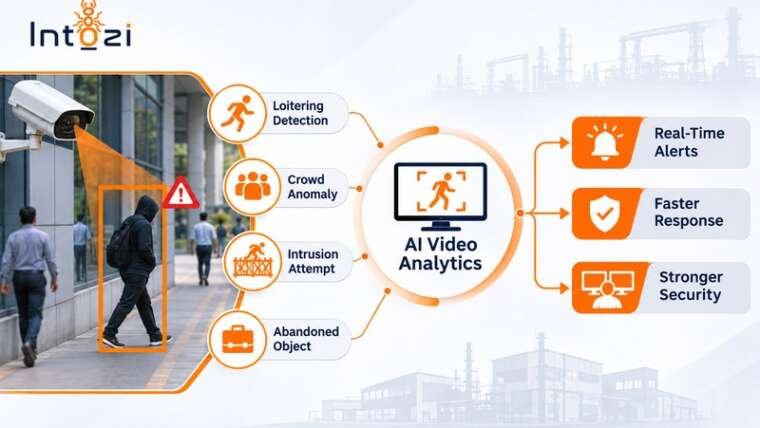
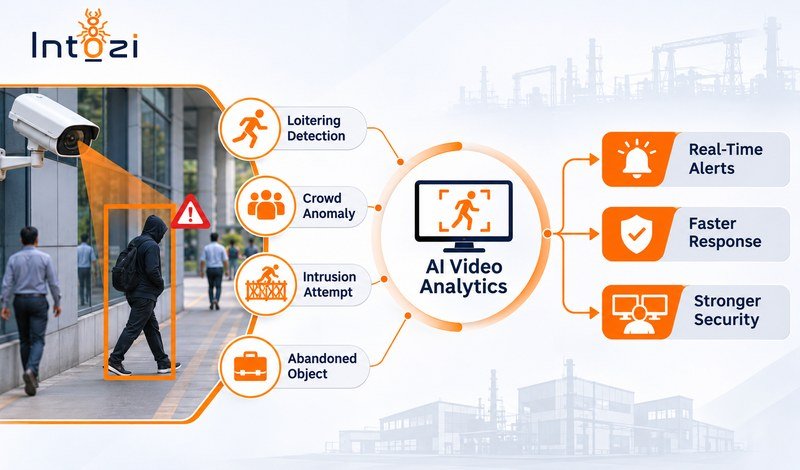
AI-based video analytics can support different security requirements by identifying configured activities across camera-covered environments. Beyond loitering detection, organisations may use computer vision for applications such as restricted-area entry detection, intrusion detection, unattended object detection, and selected movement analysis.
These capabilities can help security teams:
- Improve visibility across large facilities.
- Identify relevant events without manually reviewing every feed.
- Investigate unusual activities using recorded footage.
- Prioritise security incidents based on configured alerts.
- Strengthen existing surveillance and response procedures.
The effectiveness of these applications depends on camera placement, video quality, environmental conditions, and model configuration.
How Intozi’s Ikshana Platform Supports AI-Based Suspicious Activity Detection
Identifying unusual activity requires more than recording footage and reviewing incidents after they occur. Organisations need relevant detection capabilities that help security teams recognise configured events and investigate them efficiently. Intozi‘s Ikshana is a Vision AI platform that supports configurable video analytics applications, including loitering and suspicious activity detection use cases. Using compatible camera feeds, configured zones, and detection parameters, Ikshana can identify prolonged presence and selected activity patterns, generating alerts for further assessment. This helps organisations strengthen security operations with AI-based video intelligence while keeping human judgement central to incident verification and response.
Frequently Asked Questions (FAQs)
How does AI loitering detection software work?
AI loitering detection software identifies people in designated camera areas and analyses how long they remain within those zones. Intozi’s Ikshana platform supports configurable loitering detection applications that can generate alerts when specified duration conditions are met.
Can AI detect suspicious activities through CCTV cameras?
Yes. AI video analytics can identify configured activities such as prolonged presence, unusual movement patterns, and restricted-area entry. Intozi’s Ikshana platform supports these detection applications, helping security personnel investigate potential risks.
What is the difference between loitering detection and motion detection?
Motion detection identifies movement within a camera’s field of view, whereas loitering detection analyses how long a person remains within a defined area. Intozi’s Ikshana platform supports configurable video analytics applications for identifying prolonged presence and other selected activities.
Where can an AI loitering detection system be used?
AI loitering detection systems can be used in warehouses, commercial buildings, industrial facilities, parking areas, transportation locations, and restricted-access environments. Intozi’s Ikshana platform supports configurable applications based on camera coverage and site-specific requirements.
How does loitering analytics help prevent security incidents?
Loitering analytics helps security teams identify prolonged-presence events, recognise recurring patterns, and investigate locations that may require additional attention. Intozi’s Ikshana platform supports configurable detection applications that provide relevant video-based information for security assessment.