


Introduction
Cryptography has become an essential part of enterprise cybersecurity.
Organizations use encryption to protect customer information, financial records, employee data, intellectual property, databases, cloud storage, backups, and application information.
They also use cryptographic technologies for authentication, digital certificates, digital signatures, and secure communications.
All these capabilities depend on cryptographic keys.
As organizations expand their technology environments, the number of keys can increase significantly.
Without consistent policies, different teams may manage these keys in different ways.
This can create inconsistent access controls, unclear ownership, missed rotations, poor visibility, and unnecessary cryptographic exposure.
Centralized Key management can help organizations address these challenges.
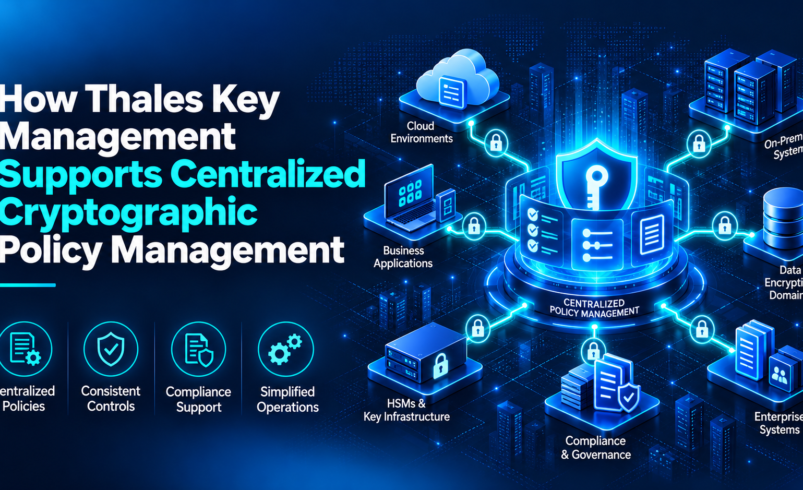
Thales key management can support enterprises that want centralized administration and policy-driven control over cryptographic keys across distributed infrastructure.
What Is Cryptographic Policy Management?
Cryptographic policy management involves establishing and enforcing rules for how organizations create, protect, use, rotate, recover, and retire cryptographic keys.
Policies can define:
- Key ownership
- Approved cryptographic mechanisms
- Access permissions
- Storage requirements
- Rotation schedules
- Backup procedures
- Recovery controls
- Monitoring requirements
- Retirement rules
These policies help create consistency across enterprise environments.
Why Centralized Policies Matter
Large enterprises may operate hundreds or thousands of applications.
Different teams may have different technical practices.
Without centralized governance, one team may rotate keys frequently while another keeps keys active for long periods.
Another team may give applications broad key permissions.
Centralized policies can establish common security objectives.
The Role of Key Management in Cryptography
Key management in cryptography provides the framework for managing cryptographic keys throughout their lifecycle.
A typical lifecycle includes:
- Generation
- Storage
- Distribution
- Access
- Usage
- Rotation
- Backup
- Recovery
- Retirement
- Destruction
Policy management should cover each stage.
Thales Key Management
Thales key management can support centralized control of cryptographic keys across enterprise environments.
Organizations can use centralized management capabilities to support policies related to:
- Key access
- Key ownership
- Key lifecycle
- Rotation
- Monitoring
- Recovery
This can help security teams maintain more consistent cryptographic governance.
Creating Enterprise Key Policies
Before implementing centralized policy management, organizations should define their requirements.
A policy framework may specify:
Key Generation
Which approved cryptographic methods should teams use?
Key Storage
Where should sensitive keys reside?
Access
Which users and applications can access each key?
Rotation
When should keys rotate?
Recovery
Who can recover a key and under what conditions?
Retirement
When should a key become inactive or be destroyed?
Centralized Key Inventory
Policy enforcement depends on visibility.
Organizations should maintain an inventory of their cryptographic keys.
The inventory should identify:
- Key owner
- Purpose
- Application
- Protected data
- Lifecycle status
- Rotation schedule
This helps security teams determine whether policies are being followed.
Enforcing Least Privilege
Least privilege should form part of enterprise cryptographic policies.
Users and applications should receive only the permissions required for their approved activities.
For example, a marketing application should not automatically access keys used by financial applications.
Centralized policy management can help organizations establish these boundaries.
Managing Key Rotation Policies
Organizations should establish rules for key rotation.
Rotation may depend on:
- Key age
- Data sensitivity
- Risk
- Application requirements
- Security policies
- Suspected compromise
A centralized policy can make rotation requirements more consistent.
Managing Cloud and On-Premises Infrastructure
Enterprises increasingly operate hybrid environments.
They may host some workloads in the cloud while maintaining other systems in traditional data centers.
Centralized policy management can help organizations establish common security requirements across both environments.
Technical implementation may differ, but the underlying security objectives can remain consistent.
Database Encryption Policies
Database encryption often protects sensitive business information.
Organizations should define policies for the associated encryption keys.
These policies can cover:
- Key ownership
- Access
- Rotation
- Backup
- Recovery
- Retirement
This creates greater consistency across database environments.
Application Encryption Policies
Applications may use cryptographic keys for:
- Data encryption
- API security
- Authentication
- Digital signatures
- Secure communications
Organizations should ensure that applications access keys through approved mechanisms.
Developers should avoid embedding sensitive cryptographic keys directly into source code.
Digital Certificate Policies
Digital certificates also require policy management.
Organizations should establish rules for:
- Certificate ownership
- Private key protection
- Expiration
- Renewal
- Replacement
- Retirement
Centralized visibility can help security teams monitor these lifecycle events.
Monitoring Policy Compliance
Organizations need to know whether teams follow cryptographic policies.
Security teams should monitor:
- Key creation
- Key access
- Key rotation
- Administrative changes
- Failed access attempts
- Key retirement
These records can help identify policy deviations.
Responding to Policy Violations
Organizations should define procedures for addressing policy violations.
For example, if an application receives excessive key permissions, security teams should review the access and remove unnecessary privileges.
If an obsolete key remains active, the organization should investigate its purpose and retire it when appropriate.
Automating Policy Enforcement
Automation can help organizations apply cryptographic policies at scale.
Organizations can automate suitable processes such as:
- Rotation reminders
- Expiration alerts
- Access reviews
- Inventory updates
- Lifecycle workflows
Automation should operate under defined governance controls.
Governance and Accountability
Centralized Key management can provide information that supports governance.
Security teams can review:
- Key ownership
- Access permissions
- Lifecycle status
- Rotation history
- Administrative activity
This information can support internal security assessments and governance reviews.
Common Challenges
Fragmented Policies
Different business units may use different Key management procedures.
Incomplete Inventory
Organizations may not know every cryptographic asset they operate.
Excessive Access
Applications may receive unnecessary key permissions.
Manual Administration
Manual processes can make policy enforcement inconsistent.
Legacy Systems
Older applications may not support modern centralized controls.
Best Practices
Organizations should:
- Define enterprise cryptographic policies
- Maintain a complete key inventory
- Assign clear ownership
- Apply least privilege
- Separate keys from protected information
- Establish rotation policies
- Automate suitable lifecycle activities
- Monitor cryptographic activity
- Review permissions regularly
- Protect key backups
- Test recovery procedures
- Retire obsolete cryptographic assets
Building a Centralized Policy Framework
A mature cryptographic governance model can follow:
Define → Inventory → Assign → Enforce → Monitor → Review → Improve
This process allows organizations to establish consistent security controls while adapting them to different technology environments.
Conclusion
As enterprise infrastructure becomes more distributed, organizations need consistent policies for managing cryptographic keys.
Thales key management can support centralized administration and policy-driven control across applications, databases, cloud platforms, and hybrid infrastructure.
Key management in cryptography provides the lifecycle framework for generating, storing, accessing, rotating, recovering, and retiring cryptographic keys.
Effective Key management combines technology with governance, access control, monitoring, automation, and clear ownership.
By implementing centralized cryptographic policies and applying them consistently across enterprise systems, organizations can improve accountability, reduce unnecessary key exposure, and strengthen the security of the encryption infrastructure protecting sensitive business information.