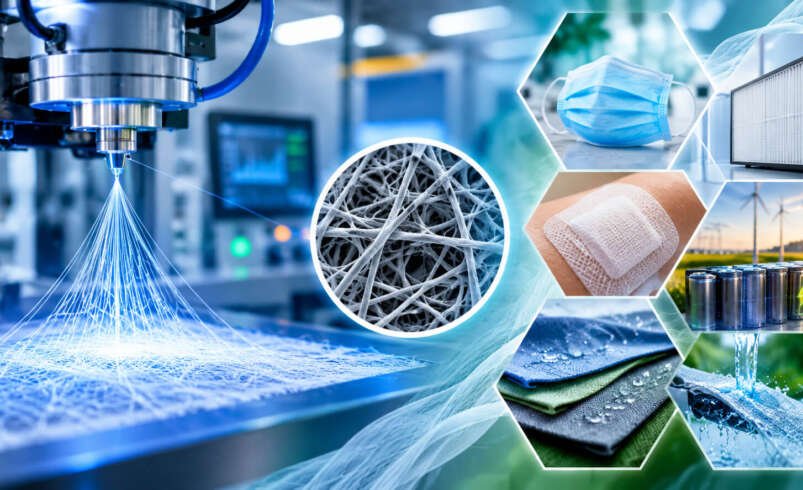

Nanofiber manufacturing is quickly moving from university labs to factory floors. Fibers thinner than one micron, often a thousand times finer than a human hair, are now powering better face masks, smarter wound dressings, longer-lasting batteries, and cleaner water.
For American manufacturers, medical device companies, and research teams, the question is no longer whether nanofibers work. It is how to produce them reliably, affordably, and at scale. In this guide, Matregenix breaks down the core technologies, real-world applications, and industry trends defining the next decade of advanced materials manufacturing.
What Is Nanofiber Manufacturing?
Nanofiber manufacturing is the process of producing continuous fibers with diameters typically between 50 and 1,000 nanometers. At this scale, materials behave differently. Nanofibers offer an extremely high surface-area-to-volume ratio, high porosity, and tiny interconnected pores.
These properties make nanofiber mats ideal for capturing particles, releasing drugs, supporting cell growth, and conducting ions. Most commercial nanofibers are made from polymers such as PCL, PLGA, nylon, PAN, PVDF, and polyurethane. That is why polymer nanofiber manufacturing remains the backbone of the industry, although ceramic, carbon, and composite nanofibers are growing fast.
Key Nanofiber Fabrication Techniques
Several nanofiber fabrication techniques are used today. Each balances fiber quality, material choice, and output differently.
Electrospinning: The Industry Standard
Electrospinning uses a high-voltage electric field to draw a charged polymer solution into ultrafine fibers that collect on a grounded surface. It is the most versatile method available. Electrospun nanofiber production works with hundreds of polymers and blends, and it allows precise control over fiber diameter, alignment, and porosity.
Needleless and Multi-Nozzle Electrospinning
Traditional single-needle setups produce only grams per hour. Needleless systems spin fibers from a free liquid surface, such as a rotating drum or wire. Multi-nozzle arrays run many jets at once. Both approaches dramatically raise throughput for industrial nanofiber manufacturing.
Centrifugal Spinning and Solution Blow Spinning
Centrifugal spinning uses rotational force instead of voltage, while solution blow spinning uses high-speed gas. Both can deliver high output rates, though they usually offer less control over fiber uniformity than electrospinning.
Melt Electrospinning and Coaxial Spinning
Melt electrospinning eliminates solvents, a major win for medical and sustainability goals. Coaxial electrospinning creates core-shell fibers that can encapsulate drugs, growth factors, or functional additives inside a protective outer layer.
The Challenge of Scalable Nanofiber Production
Nanofiber production scalability has long been the industry’s biggest hurdle. A material that performs beautifully in a lab sample can fail commercially if it cannot be made consistently in large volumes. The main obstacles include:
- Low throughput from single-jet systems that cannot meet commercial demand.
- Batch-to-batch variability in fiber diameter, thickness, and porosity.
- Environmental sensitivity, since humidity and temperature directly affect fiber formation.
- Solvent handling and the safety, cost, and regulatory concerns that come with it.
- Quality control for medical and filtration products that must meet FDA, ISO, or NIOSH standards.
Modern nanofiber processing technology is closing these gaps. Roll-to-roll systems deposit fibers continuously onto moving substrates. Climate-controlled spinning chambers keep conditions stable. Inline monitoring tracks fiber quality in real time. Together, these advances make scalable nanofiber production practical for commercial launches rather than just pilot runs.
Major Applications of Nanofibers Across Industries
Healthcare and Biomedical Devices
Nanofibers closely mimic the body’s extracellular matrix. This makes them ideal for tissue engineering scaffolds, vascular grafts, nerve guides, and advanced wound dressings. Drug-loaded nanofibers enable controlled, localized release, and nanofiber coatings can improve how implants integrate with tissue.
Air and Liquid Filtration
Nanofiber filter media capture fine particles, bacteria, and viruses while keeping airflow resistance low. Applications range from N95-style respirators and HVAC filters to cleanroom systems and water purification membranes.
Energy Storage and Conversion
In batteries, nanofiber separators improve ion transport and thermal stability. Carbon and ceramic nanofibers are also used as electrodes in lithium-ion batteries, supercapacitors, and fuel cells.
Textiles, Defense, and Electronics
Breathable waterproof fabrics, protective clothing against chemical threats, flexible sensors, and wearable electronics all benefit from nanofiber layers. The US defense and aerospace sectors are especially active in this space.
Industry Trends Shaping the Future of Nanofiber Manufacturing
1. Industrial Scale-Up Goes Mainstream
Companies are moving from pilot equipment to full production lines. Demand for industrial nanofiber manufacturing is rising as more nanofiber products clear regulatory review and enter commercial markets.
2. Green and Solvent-Free Processing
Sustainability is a growing priority for US buyers. Water-based polymer systems, melt electrospinning, and biodegradable materials such as PLA and chitosan are gaining traction.
3. Smart and Multifunctional Fibers
Next-generation nanofibers do more than one job. Antimicrobial filters, conductive scaffolds, and sensor-embedded fabrics combine several functions in a single material layer.
4. AI and Process Automation
Machine learning helps predict how solution properties and process settings affect fiber output. Automated feedback systems are reducing waste and improving consistency across large production runs.
5. Domestic Supply Chain Growth
Recent supply disruptions pushed US companies to secure local sources for filtration media and medical materials. This shift is fueling investment in American advanced materials manufacturing and contract nanofiber production.
How Matregenix Is Advancing Nanofiber Manufacturing
Based in California, Matregenix specializes in electrospun nanofiber production and helps companies turn nanofiber concepts into commercial products. Our team supports clients at every stage:
- Research and development: Custom material formulation and fiber design for specific performance targets.
- Prototyping: Fast sample production for testing, validation, and investor demonstrations.
- Scale-up: Transition from lab-scale results to repeatable, scalable nanofiber production.
- Contract manufacturing: Consistent, high-quality nanofiber materials for medical, filtration, energy, and industrial applications.
- Electrospinning equipment: Systems designed for both research labs and production environments.
By combining deep materials expertise with proven nanofiber processing technology, Matregenix helps partners reduce development risk and shorten their path to market.
Conclusion: The Road Ahead for Nanofiber Manufacturing
The future of nanofiber manufacturing is defined by scale, precision, and purpose. Electrospinning continues to lead the field, while needleless systems, solvent-free methods, and smart automation are making high-volume production a commercial reality. From life-saving medical devices to cleaner air and better batteries, nanofibers are set to become a core part of US advanced materials manufacturing.
Companies that invest early in reliable, scalable production partners will be best positioned to lead their markets.
Ready to bring your nanofiber product to market? Contact Matregenix today to discuss your project, request samples, or explore our electrospinning and contract manufacturing services.
Frequently Asked Questions
What is the most common method of nanofiber manufacturing?
Electrospinning is the most widely used method because it works with many polymers and offers precise control over fiber structure.
Can nanofibers be produced at industrial scale?
Yes. Needleless electrospinning, multi-nozzle systems, and roll-to-roll processing now support industrial nanofiber manufacturing at commercial volumes.
Which industries use nanofibers the most?
Healthcare, filtration, energy storage, protective textiles, and electronics are the leading markets for nanofiber materials.