

What Is a Healthy BMI for Men and Women?
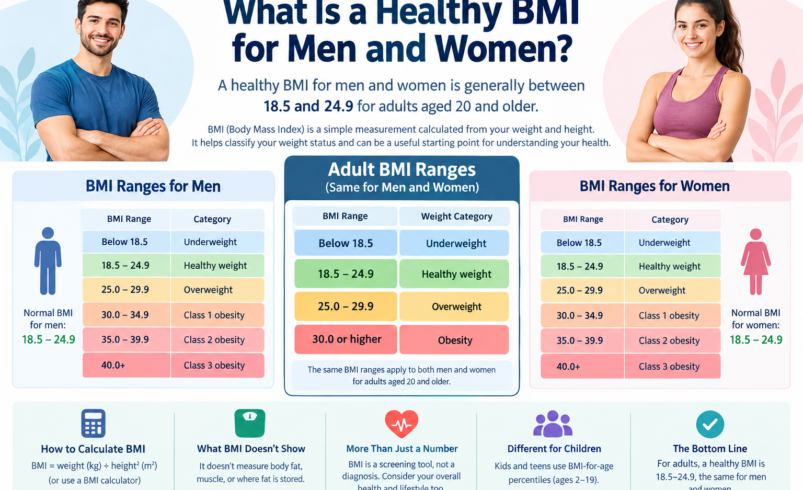
A healthy BMI for men and women is generally between 18.5 and 24.9 for adults aged 20 and older. Body mass index (BMI) is a measurement calculated from your weight and height and is used as a screening tool to classify weight status. For adults, the standard BMI ranges are the same for men and women, although BMI does not account for differences in muscle mass, body composition, or where body fat is stored.
Use a BMI calculator to enter your height and weight and get your BMI value. Once you have the result, compare it with the BMI ranges below to understand which weight category it falls into.
What Are the BMI Ranges for Adults?
For adults 20 and older, the standard BMI ranges are divided into four main categories:
| BMI | Weight Category |
|---|---|
| Below 18.5 | Underweight |
| 18.5–24.9 | Healthy weight |
| 25.0–29.9 | Overweight |
| 30.0 or higher | Obesity |
These BMI index ranges apply to both men and women. The CDC further divides obesity into three classes: Class 1 is 30 to less than 35, Class 2 is 35 to less than 40, and Class 3 is 40 or higher.
The healthy BMI range is therefore 18.5 to 24.9 for adult men and women. However, being within this range does not by itself prove that a person is healthy, just as being outside it does not provide a diagnosis. BMI should be considered alongside other health information.
BMI Ranges for Women
The standard BMI ranges for women aged 20 and older are:
| BMI Range | Category |
|---|---|
| Below 18.5 | Underweight |
| 18.5–24.9 | Healthy weight |
| 25.0–29.9 | Overweight |
| 30.0 or higher | Obesity |
There is not a separate adult female BMI scale with different cutoffs simply because someone is a woman. Standard adult BMI categories are based on BMI value rather than sex.
This means a normal BMI range for women is generally 18.5 to 24.9 when using the standard adult classification.
A woman’s BMI can still be interpreted in the context of factors that BMI does not measure, including muscle mass, medical history, physical activity, and other health measurements.
Female Body Mass Index Range Chart
A simple female body mass index range chart for adults is:
| Female BMI | BMI Classification |
|---|---|
| Under 18.5 | Underweight |
| 18.5–24.9 | Healthy weight |
| 25.0–29.9 | Overweight |
| 30.0–34.9 | Class 1 obesity |
| 35.0–39.9 | Class 2 obesity |
| 40.0+ | Class 3 obesity |
These are the standard adult BMI classifications rather than sex-specific thresholds.
BMI Ranges for Men
The standard BMI ranges for men aged 20 and older are also:
| BMI Range | Category |
|---|---|
| Below 18.5 | Underweight |
| 18.5–24.9 | Healthy weight |
| 25.0–29.9 | Overweight |
| 30.0 or higher | Obesity |
Therefore, a normal BMI for men is generally considered 18.5 to 24.9 under the standard adult BMI classification. The same thresholds are used for adult women.
Male BMI Table
| Male BMI | BMI Classification |
|---|---|
| Under 18.5 | Underweight |
| 18.5–24.9 | Healthy weight |
| 25.0–29.9 | Overweight |
| 30.0–34.9 | Class 1 obesity |
| 35.0–39.9 | Class 2 obesity |
| 40.0+ | Class 3 obesity |
A person’s BMI category is only one part of a broader health assessment. For example, someone with a high amount of muscle may have a higher BMI because muscle contributes to body weight, even though BMI cannot distinguish muscle from fat.
Is BMI the Same for Men and Women?
For adults, the standard BMI categories are the same for men and women. A BMI of 22, for example, falls within the healthy weight range regardless of whether the adult is male or female.
This answers a common question: Is BMI calculated differently for men and women?
The basic adult BMI calculation is not sex-specific. It uses weight and height:
BMI = weight (kg) ÷ height² (m²)
For U.S. customary measurements:
BMI = [weight (lb) ÷ height² (in)] × 703
The CDC uses these formulas for calculating BMI in adults.
However, the fact that the calculation and categories are the same does not mean BMI has exactly the same biological meaning for every person. Men and women can differ in body composition, including the amount and distribution of muscle and body fat. BMI itself does not measure those differences.
BMI Male vs Female: What Is the Difference?
When comparing BMI male vs female, the main distinction is not the BMI cutoff itself. Standard adult BMI ranges use the same numerical categories for both sexes.
The difference is in what BMI leaves out.
BMI is based only on weight relative to height. It cannot directly determine:
- How much of your weight comes from muscle
- How much comes from body fat
- Where body fat is stored
- Your overall fitness level
- Your complete health status
For this reason, two people with the same BMI can have different body compositions and health profiles. The CDC recommends considering BMI alongside other information, such as medical history, health behaviors, physical examination findings, and laboratory findings.
BMI Chart for Male and Female Adults
The following BMI chart for male and female adults provides a quick reference:
| BMI | Men | Women |
|---|---|---|
| Below 18.5 | Underweight | Underweight |
| 18.5–24.9 | Healthy weight | Healthy weight |
| 25.0–29.9 | Overweight | Overweight |
| 30.0–34.9 | Class 1 obesity | Class 1 obesity |
| 35.0–39.9 | Class 2 obesity | Class 2 obesity |
| 40.0+ | Class 3 obesity | Class 3 obesity |
For adults 20 and older, these are the standard BMI index ranges used by the CDC.
BMI by Height: How Height Changes the Healthy Weight Range
BMI depends on both height and weight. Because of this, there is no single body weight that represents a healthy BMI for everyone.
For example, a person who is 5 feet tall and a person who is 6 feet tall would generally need different body weights to have the same BMI.
A BMI by height chart can therefore be useful when you want to see approximately how different weights correspond to BMI categories at a particular height.
For a specific person, the easiest approach is to enter their height and weight into a BMI calculator rather than trying to estimate their BMI from a general chart.
Example: BMI at 5’7″
Suppose an adult is 5’7″ tall. Their BMI will depend on their weight. The same BMI thresholds still apply:
- Below 18.5: underweight
- 18.5–24.9: healthy weight
- 25.0–29.9: overweight
- 30.0 or higher: obesity
The BMI classification does not change because the person is male or female.
What Is a Healthy BMI?
For adults aged 20 and older, a healthy BMI range is 18.5 to 24.9.
It is important to understand what “healthy” means in this context. BMI is a screening measurement that helps identify weight categories. It is not a complete assessment of an individual’s health and should not be treated as a diagnosis.
For example, a person with a BMI of 23 falls within the standard healthy weight range, but that number alone cannot describe their body composition, fitness, blood pressure, cholesterol, or other aspects of health.
Likewise, someone outside the healthy BMI range may need additional information before conclusions can be made about their individual health.
BMI and Ideal Body Weight
BMI and ideal body weight are not the same thing.
BMI gives you a number based on your height and weight and places that number into a classification. It does not calculate a single “ideal” weight that every person of a particular height should have.
Different people with the same height can have different body compositions and health needs. Therefore, an ideal body weight should not be inferred from BMI alone.
If you are trying to understand whether your current weight is appropriate for you, BMI can be one useful starting point, but other factors may also be relevant.
What Does an Overweight or Obese BMI Mean?
For adults, a BMI from 25.0 to 29.9 falls into the overweight category, while a BMI of 30.0 or higher falls into the obesity category.
Obesity is further classified into:
- Class 1: BMI 30.0–34.9
- Class 2: BMI 35.0–39.9
- Class 3: BMI 40.0 or higher
A BMI in these categories can be associated with increased health risks, but BMI alone does not diagnose a disease. The CDC notes that BMI should be considered together with other health factors.
Does BMI Directly Measure Body Fat?
No. BMI does not directly measure body fat.
BMI uses height and weight, so it cannot distinguish between fat mass and lean mass such as muscle and bone. This is one reason BMI can sometimes classify a muscular person as overweight even when their body composition differs from what the BMI category might suggest.
BMI also does not show where fat is stored in the body.
For a more complete assessment, a healthcare professional may consider additional information such as medical history, physical examination findings, health behaviors, and laboratory measurements.
Are BMI Ranges Different for Older Adults?
The standard adult BMI categories apply to adults aged 20 and older regardless of age, sex, or race.
However, age can be relevant when interpreting a person’s overall health because BMI does not capture changes in muscle mass, body composition, or other factors that can occur with aging.
For that reason, BMI should be viewed as one health indicator rather than a complete measure of health.
BMI for Children and Teenagers Is Different
The adult BMI ranges should not be used to interpret BMI for children and teenagers.
For children and teens ages 2 through 19, BMI is interpreted using BMI-for-age percentiles, which account for age and sex. The CDC provides a separate child and teen BMI calculator for this purpose.
This distinction is important if you are looking for a BMI chart for a child rather than an adult.
How to Use a BMI Calculator
Calculating your BMI is straightforward:
- Measure your height.
- Measure your weight.
- Enter both values into a BMI calculator.
- Choose the appropriate measurement units.
- Review your BMI value.
- Compare the result with the adult BMI ranges.
For metric measurements, BMI is calculated by dividing weight in kilograms by height in meters squared. For U.S. customary measurements, weight in pounds and height in inches are used with the appropriate conversion factor.
A BMI calculator makes this process easier because it performs the calculation automatically and shows the corresponding category.
Frequently Asked Questions About BMI Ranges
What is a normal BMI range for women?
For adult women aged 20 and older, the standard healthy BMI range is 18.5 to 24.9. The same adult BMI range is used for men.
What is a normal BMI range for men?
For adult men aged 20 and older, the standard healthy BMI range is 18.5 to 24.9.
Is BMI the same for men and women?
Yes. The standard adult BMI categories and numerical thresholds are the same for men and women. However, BMI does not account for sex-related differences in body composition.
What BMI is considered overweight?
For adults, a BMI from 25.0 to 29.9 is classified as overweight.
What BMI is considered obesity?
For adults, a BMI of 30.0 or higher falls into the obesity category.
Is a BMI of 18.5 to 24.9 healthy?
This range is classified as healthy weight for adults under the standard BMI system. However, BMI is a screening measure and should be considered with other health information.
Does BMI change for men and women?
The standard adult BMI calculation and categories do not change based on sex. The same BMI ranges are used for adult men and women.
Can a muscular person have a high BMI?
Yes. BMI cannot distinguish muscle from fat, so a person with substantial muscle mass may have a BMI in the overweight or obesity category despite having a different body composition.
The Bottom Line
For adults aged 20 and older, the standard BMI ranges are the same for men and women. A BMI of 18.5 to 24.9 falls within the healthy weight category, while values below 18.5 are classified as underweight, 25.0 to 29.9 as overweight, and 30.0 or higher as obesity.
BMI is useful as a quick screening measure, but it does not tell the whole story. It does not directly measure body fat or distinguish fat from muscle and bone. For a more complete understanding of your health, BMI should be considered alongside other relevant measurements and personal health information.