

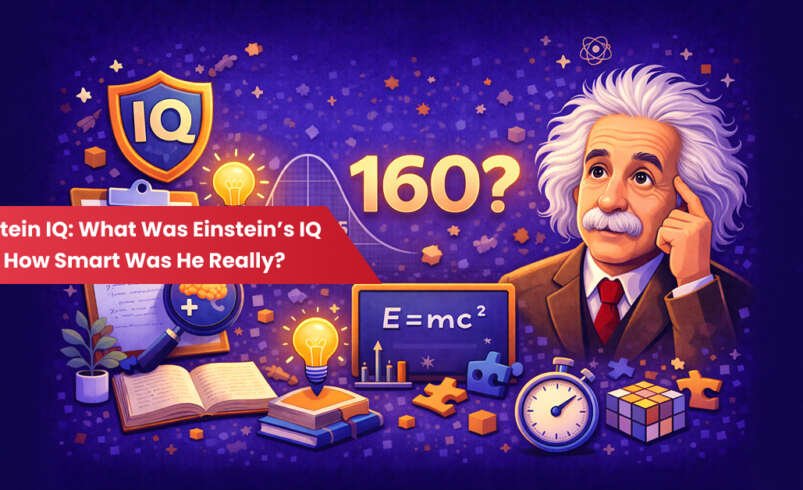

Albert Einstein is widely regarded as one of the greatest scientific minds in history. His theories transformed our understanding of space, time, gravity, light, and energy, making his name almost synonymous with genius. Even more than a century after his most important discoveries, people remain fascinated by his intellectual abilities. One of the most frequently searched questions is about albert einstein iq and whether his intelligence can explain his extraordinary scientific achievements.
Although many websites claim that Einstein had an IQ of 160 or higher, there is no reliable historical evidence that he ever took a standardized IQ test. His exact IQ therefore remains unknown. However, his scientific accomplishments provide powerful evidence of an exceptional intellect. Einstein’s genius was not simply about solving mathematical problems quickly. His greatest strength was his ability to question established ideas, imagine possibilities that others overlooked, and develop entirely new ways of understanding physical reality.
What Was Albert Einstein’s IQ?
There is no verified record of Albert Einstein receiving an official IQ score. The commonly repeated figure of 160 is an estimate that appeared long after his most important scientific achievements. It should not be treated as a documented fact.
The concept of IQ testing existed during Einstein’s lifetime, but standardized intelligence tests were not used in the way they are today to evaluate historical figures. Consequently, any precise number assigned to Einstein is speculative.
This distinction is important when discussing albert einstein iq. An IQ score can measure certain aspects of reasoning and problem solving, but it cannot fully measure scientific creativity, originality, curiosity, imagination, or the ability to challenge fundamental assumptions.
Einstein’s life demonstrates why genius cannot be reduced to a single numerical score.
Einstein’s Early Interest in Science
Albert Einstein was born in 1879 in Ulm, Germany. From an early age, he developed a strong interest in mathematics and science. One famous story describes how a compass fascinated him as a child because its needle moved even though nothing visibly appeared to push it.
Whether every detail of the story is historically precise or not, it reflects an important characteristic of Einstein’s personality. He was deeply curious about invisible forces and the underlying principles governing nature.
As he grew older, Einstein became increasingly interested in physics. He studied at the Swiss Federal Polytechnic in Zurich and eventually developed ideas that would challenge some of the most established assumptions in classical physics.
His intellectual journey shows that curiosity was one of the foundations of his scientific success.
The Miracle Year of 1905
Einstein’s reputation as a scientific genius was firmly established in 1905. During that remarkable year, he published four major scientific papers that addressed some of the most important problems in physics.
One of these papers explained the photoelectric effect by proposing that light could behave as if it were made up of discrete packets of energy. This work helped establish the foundations of quantum theory and later earned Einstein the Nobel Prize in Physics.
Another paper provided important evidence for the existence of atoms and molecules by analyzing Brownian motion.
Einstein also introduced special relativity, which radically changed the traditional understanding of space and time.
Finally, he presented the famous relationship between mass and energy:
E = mc²
The equation demonstrated that mass and energy are deeply connected. It became one of the most recognizable equations in science.
The fact that one person could make several major contributions to physics in such a short period is one reason Einstein’s intellectual abilities became legendary.
Special Relativity Changed the Meaning of Time
Before Einstein, Newtonian physics treated space and time as largely independent and absolute. Einstein challenged this assumption through special relativity.
His theory showed that measurements of time and space depend on the observer’s state of motion. Time is not experienced identically by all observers under all circumstances.
This was an extraordinary conceptual shift.
Einstein did not simply improve an existing formula. He changed the framework scientists used to describe reality.
His ability to question basic assumptions was central to his genius. Instead of asking only how existing equations could be improved, Einstein asked whether the assumptions behind those equations were correct.
This approach is a major reason why discussions about albert einstein iq should go beyond numbers. His greatest strength was not merely computational intelligence. It was conceptual imagination.
General Relativity and Gravity
Einstein continued developing his ideas about relativity and eventually produced general relativity in 1915.
Newton had described gravity as a force acting between objects with mass. Einstein offered a radically different interpretation. According to general relativity, massive objects curve spacetime, and this curvature influences how matter and light move.
The theory was mathematically complex, but its conceptual foundation was revolutionary.
One of the most famous predictions of general relativity was that gravity could bend light. In 1919, observations of a solar eclipse provided evidence supporting Einstein’s prediction. The results received worldwide attention and helped turn Einstein into an international celebrity.
General relativity remains one of the foundations of modern physics. It has influenced research in cosmology, black holes, gravitational waves, and the structure of the universe.
Einstein’s Genius Was More Than Mathematics
It is tempting to imagine Einstein as a human calculator who could instantly solve complicated equations. However, that image does not accurately describe what made him exceptional.
Einstein was particularly skilled at conceptual reasoning. He used thought experiments to explore physical situations that were difficult or impossible to reproduce directly.
He imagined scenarios involving observers, moving trains, clocks, beams of light, and other hypothetical situations. By following the logical consequences of these scenarios, he was able to uncover contradictions in conventional thinking.
This ability to visualize abstract concepts was a major part of his scientific creativity.
For this reason, a supposed albert einstein iq score cannot explain his achievements by itself. Intelligence tests do not fully capture the kind of imaginative reasoning that allowed Einstein to rethink the foundations of physics.
Einstein and the Nature of Light
Einstein also made important contributions to our understanding of light.
His explanation of the photoelectric effect suggested that light could behave as discrete packets of energy. These packets were later called photons.
This work was extremely important because it helped establish the quantum nature of light.
Interestingly, Einstein later became skeptical of some interpretations of quantum mechanics, particularly the idea that fundamental physical events might be governed by inherent randomness.
His famous disagreements with other physicists, including Niels Bohr, became part of the history of modern physics.
Even when Einstein disagreed with emerging ideas, his willingness to debate fundamental questions demonstrated his commitment to understanding the deeper principles of nature.
How Einstein Changed Modern Physics
Einstein’s influence extends far beyond the theories that carry his name.
Special and general relativity became essential parts of modern physics. His work on the photoelectric effect helped establish quantum theory. His analysis of Brownian motion supported the atomic theory of matter.
His ideas also influenced astronomy and cosmology.
Modern scientists use Einstein’s theories to study black holes, gravitational waves, neutron stars, galaxies, and the evolution of the universe. Technologies such as the Global Positioning System also require corrections based on relativistic effects to maintain accurate timing.
This demonstrates that Einstein’s ideas were not simply philosophical concepts. They continue to influence practical technology and modern scientific research.
Was Einstein’s IQ the Secret to His Genius?
The fascination with albert einstein iq often comes from the desire to find a simple explanation for extraordinary achievement.
However, Einstein’s story suggests that genius is more complicated.
His accomplishments were supported by extensive knowledge, persistence, curiosity, mathematical ability, imagination, and intellectual independence.
He was willing to challenge ideas that had been accepted for generations. He also spent enormous amounts of time thinking about difficult problems.
A high IQ may help with certain forms of reasoning, but it does not automatically produce scientific breakthroughs. Creativity and originality are equally important.
Einstein’s success came from combining different intellectual strengths rather than relying on a single measurable trait.
The Legacy of Albert Einstein
Albert Einstein died in 1955, but his influence on science remains enormous.
His theories changed how scientists understand space and time. His work helped establish important parts of modern quantum physics. His ideas transformed cosmology and continue to guide research into some of the universe’s most mysterious objects and phenomena.
His cultural legacy is equally remarkable. His face, name, and equation E = mc² have become symbols of intelligence around the world.
Yet perhaps the most important lesson from Einstein’s life is not his supposed IQ.
Einstein demonstrated the power of questioning assumptions. He showed that progress can begin with a simple but profound question about something everyone else takes for granted.
Conclusion
The exact albert einstein iq remains unknown because there is no reliable evidence that Einstein ever received a standardized IQ score. Numbers such as 160 are popular estimates, not confirmed historical facts.
What is certain is that Einstein possessed extraordinary intellectual abilities. His theories of special and general relativity transformed physics, while his work on the photoelectric effect and Brownian motion helped shape modern science.
His genius came from more than raw intelligence. Curiosity, imagination, persistence, conceptual reasoning, and the courage to challenge established ideas all played important roles.
Einstein’s greatest contribution was not simply that he knew more than others. It was that he learned to see familiar problems differently. By questioning the nature of time, space, light, gravity, and energy, he changed humanity’s understanding of the universe