

Creating Smarter Customer Journeys With Artificial Intelligence
AI CRM for service businesses is changing how companies capture enquiries, organise customer information, qualify prospects, and manage sales conversations. Service businesses often depend on quick communication and strong relationships because customers usually need information, guidance, or consultation before deciding to purchase.
Traditional CRM systems can organise contacts and sales activities, but artificial intelligence can add another layer of automation and decision support. Instead of simply storing customer information, an AI-enabled system can help businesses understand incoming leads, prioritise opportunities, automate routine actions, and keep sales teams informed.
This can be particularly useful for businesses dealing with a high volume of enquiries across websites, messaging platforms, advertisements, and other channels.
Understanding the Modern Service Business Sales Journey
The customer journey for a service business is rarely as simple as clicking a button and completing a purchase. A prospect may first discover a company through an advertisement, visit its website, ask a question, request pricing, book a consultation, and then spend several days considering the available options.
Each stage creates information that can be useful to the sales team.
An AI-powered CRM can help bring these interactions into one organised environment. Customer details, conversations, tasks, and sales stages can be connected so representatives have better context when communicating with prospects.
Capturing Leads Without Creating Extra Administrative Work
Lead generation campaigns can produce enquiries at different times of the day. Some arrive during office hours, while others appear in the evening or at weekends.
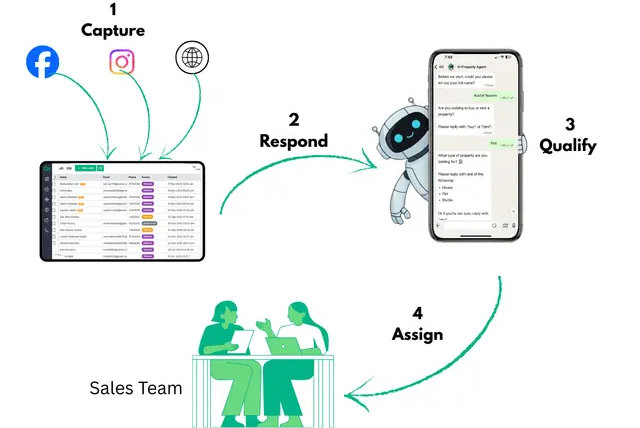
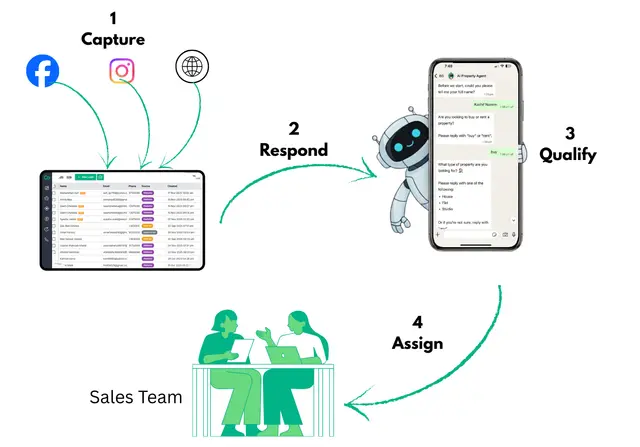
Manually processing every enquiry can put pressure on sales teams. An automated CRM can capture lead information and organise it according to predefined workflows.
This means new prospects can enter the sales process without requiring an employee to manually copy information between different systems.
Using AI to Understand Lead Intent
Not every enquiry indicates the same level of interest. One person may simply want general information, while another may be ready to schedule a consultation.
AI can assist businesses by analysing available lead information and identifying relevant characteristics. Depending on the system and its configuration, leads can be organised according to factors such as service requirements, urgency, responses, or other qualification criteria.
This gives sales teams a more useful starting point when deciding which prospects should receive immediate attention.
Making Customer Communication Available Around the Clock
Customers do not always contact businesses during traditional working hours. A potential client may have a question late at night and expect some form of immediate response.
Automated communication can help businesses remain available beyond normal office schedules. Basic questions can be answered automatically, while more complex enquiries can be passed to the appropriate team member for later attention.
This can help reduce communication gaps without requiring employees to remain online continuously.
Bringing WhatsApp Into the AI Sales Process
For businesses that receive a large number of enquiries through messaging, a WhatsApp AI sales agent can provide an automated first point of contact. It can respond to common questions, collect relevant information, qualify prospects, and help move conversations toward the next sales step.
Instead of treating WhatsApp as an isolated communication channel, businesses can connect messaging activity with their wider CRM workflow.
This can allow a prospect’s conversation to become part of a structured sales process rather than remaining inside a standalone chat history.
Reducing Repetitive Questions for Sales Teams
Sales representatives often answer the same basic questions repeatedly. Customers may ask about services, availability, pricing structures, processes, or next steps.
AI automation can handle suitable routine questions while allowing human representatives to focus on more detailed conversations.
This does not mean every interaction needs to be automated. The purpose is to reduce repetitive work where automation is appropriate and give sales teams more time for activities that require judgement and personal communication.
Creating Personalised Follow-Up Workflows
Follow-up is one of the most important parts of service business sales. A prospect may be interested but not ready to make a decision immediately.
AI-powered CRM workflows can help businesses create follow-up sequences based on customer activity and sales stages. Reminders can be generated when an opportunity requires attention, while communication workflows can be triggered according to predefined conditions.
Personalisation remains important. Automated communication can use available customer information to make messages more relevant instead of sending the same generic message to every prospect.
Connecting Sales and Customer Information
Service businesses often need more information than a customer’s name and phone number. Sales representatives may need to know what service the prospect requested, what was previously discussed, which questions were asked, and what action is expected next.
A centralised CRM can keep these details connected to the customer record.
When a prospect speaks with another member of the team, the new representative can review the available information rather than beginning the conversation without context.
Helping Teams Prioritise Their Work
A growing business can have hundreds of contacts at different stages. Without prioritisation, sales representatives may spend too much time deciding which opportunity to handle first.
AI-assisted systems can help organise leads according to business rules and available information. High-priority opportunities can be highlighted while less urgent contacts remain within an organised follow-up process.
This can make daily sales activity more structured and reduce the amount of manual sorting required from employees.
Improving the Handover From AI to Human Teams
Automation works best when there is a clear point at which human representatives take over.
A prospect may begin with an automated conversation but eventually need a detailed consultation, customised quotation, or specialist explanation. The CRM should retain the information gathered during the automated interaction so the human representative can continue the conversation with context.
This creates a smoother transition between automated and human communication.
Supporting Different Service Industries
AI CRM technology can support many types of service businesses. Real estate companies can use it to manage property enquiries, agencies can organise potential clients, education providers can handle course enquiries, coaches can manage consultation requests, and solar businesses can organise installation leads.
The specific sales process may differ between industries, but the underlying needs are often similar: capture the enquiry, understand the customer, qualify the opportunity, follow up, and maintain the relationship.
Using Customer Data for Better Sales Insights
An AI-enabled CRM can also help businesses understand patterns within their sales activity.
Managers can review information about lead sources, customer requirements, response activity, pipeline stages, and conversions. These insights can help identify areas where the sales process is performing well and areas that may require additional attention.
Over time, this information can support decisions about marketing campaigns, staffing, follow-up processes, and customer engagement.
Making Growth Easier to Manage
As a service business grows, increasing lead volume can create additional administrative pressure. Hiring more people may help, but simply adding employees does not necessarily solve inefficient processes.
Automation can provide scalable support by handling repetitive activities while maintaining organised customer records. Sales representatives can then concentrate on consultations, relationship building, and opportunities that require human input.
LastingSales combines CRM functionality with AI-powered lead qualification, automated follow-ups, WhatsApp sales automation, lead management, and mobile access. These capabilities can help service businesses build a more connected sales process as their customer base expands.
Conclusion
Artificial intelligence is becoming an increasingly useful part of modern sales management. For service businesses, the value goes beyond simply automating messages. AI can help organise enquiries, identify potential opportunities, support customer conversations, create follow-up workflows, and provide sales teams with better information.
When AI automation is combined with a centralised CRM, businesses can create a more consistent customer journey from the first enquiry through to conversion and ongoing relationship management.
The combination of intelligent qualification, automated communication, organised customer records, and human sales expertise can provide service businesses with a practical framework for managing growing demand while keeping customer interactions connected and relevant.