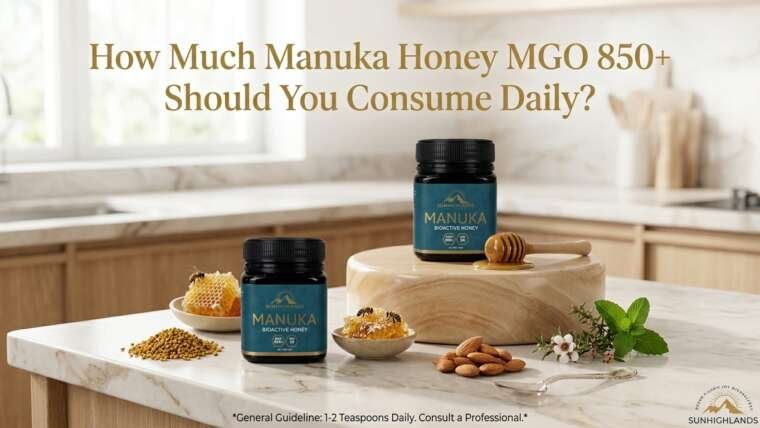


Manuka honey is often enjoyed as a premium food, but one of the most common questions buyers have is: how much Manuka Honey MGO 850+ should you consume daily?
The answer is not as simple as choosing a larger amount because the MGO rating is higher. MGO 850+ describes the concentration of methylglyoxal (MGO) in the honey; it does not establish a universal daily dose. Your ideal intake can depend on your overall diet, dietary needs, personal preferences and how you intend to use the honey.
For Australian consumers, understanding the serving size, nutritional information and the meaning of the MGO rating can help you enjoy high-MGO Manuka honey responsibly.
What Does MGO 850+ Mean?
MGO stands for methylglyoxal, a naturally occurring compound associated with the distinctive characteristics of Manuka honey.
MGO develops from dihydroxyacetone (DHA), which occurs naturally in the nectar of some Leptospermum plants. As Manuka honey matures, DHA can convert into MGO, creating a measurable concentration in the finished honey. The Australian Manuka Honey Association (AMHA) identifies MGO as an important measurement in its Australian Manuka honey quality framework.
An MGO 850+ label therefore describes a high concentration of MGO. It is a product-strength measurement, not a prescription or medical dosage.
This distinction is important because a higher MGO number does not automatically mean that you should consume a larger quantity.
How Much MGO 850+ Manuka Honey Does the Product Recommend?
The Sunhighlands MGO 850+ product information lists a recommended serving size of 10 g. The 250 g product contains 25 servings based on that serving size.
The manufacturer’s FAQ also states a recommended daily amount of 10 g.
For someone following the product’s stated serving guidance, 10 g provides a straightforward reference point for daily consumption.
However, consumers should understand that a manufacturer’s serving suggestion is not the same as a medically established daily requirement. There is no general rule that every adult needs exactly 10 g of MGO 850+ Manuka honey every day.
What Does 10 g Mean Nutritionally?
The amount of honey matters because Manuka honey is still honey, meaning it naturally contains carbohydrates and sugars.
According to the Sunhighlands nutrition information for its MGO 850+ product, a 10 g serving contains approximately 141 kJ of energy, 8.2 g of carbohydrate and 8.2 g of total sugars.
This is useful information when deciding how much honey fits into your daily diet.
For example, if you already consume other sweet foods or drinks during the day, you may want to account for the honey as part of your overall sugar intake.
The Australian Guide to Healthy Eating recommends eating a wide variety of nutritious foods from the five food groups and limiting foods and drinks containing added sugars to small amounts and only sometimes.
Although honey occurs naturally, it still contributes sugar and energy to the diet.
Is More MGO a Reason to Consume More Honey?
No.
This is one of the most important points to understand about Manuka Honey MGO 850+.
MGO indicates the concentration of methylglyoxal in the product. It does not mean that you should increase the amount of honey you consume simply because the MGO rating is high.
For example, MGO 850+ and MGO 1200+ represent different MGO concentrations, but it would not be appropriate to conclude that a person should consume more of the higher-rated product.
The amount you eat and the MGO concentration are two separate considerations.
Think of the MGO number as describing what is in the honey, while the serving size describes how much honey you are consuming.
Can You Take MGO 850+ Every Day?
For healthy adults who enjoy Manuka honey as a food, a daily serving can fit into an overall balanced eating pattern.
The referenced Sunhighlands product is specifically marketed for daily enjoyment, and its listed serving size is 10 g.
However, “daily” does not mean that everyone needs to consume it every day.
Some people may prefer to use Manuka honey occasionally, while others may include a small amount in breakfast or beverages as part of their regular routine.
Your overall dietary pattern is more important than treating Manuka honey as a compulsory daily supplement.
The Best Time to Consume Manuka Honey
There is no single time of day that everyone must follow.
You can enjoy MGO 850+ Manuka honey at different points throughout the day depending on how you like to use it.
In the Morning
Add a measured serving to:
- Porridge
- Greek yoghurt
- Toast
- Fresh fruit
- Smoothies
This is one of the easiest ways to incorporate honey into breakfast without changing your usual routine.
During the Afternoon
A small amount can be paired with a snack such as fruit, yoghurt or wholegrain toast.
In the Evening
Some people enjoy honey in a warm drink or as a topping for yoghurt or fruit.
The important consideration is not whether you consume it at 7 am or 7 pm, but how the serving fits into your overall food intake.
Should You Consume MGO 850+ on an Empty Stomach?
There is no general requirement that Manuka honey must be consumed on an empty stomach.
You can take it with breakfast, as part of a snack or alongside other foods.
Some online discussions recommend consuming Manuka honey first thing in the morning or before meals, but such routines should not be confused with a universally established dietary requirement.
For everyday enjoyment, choose a routine that is practical and comfortable for you.
Can You Divide the 10 g Serving Throughout the Day?
Yes, you can incorporate a serving into your meals and snacks rather than consuming it all at once.
For example, you might add part of your daily amount to breakfast and the remainder to a warm drink later in the day.
There is no special requirement for all honey to be consumed in a single sitting when it is being used as a food.
What matters most is keeping track of the total amount you consume.
If you are using the manufacturer’s 10 g serving as your daily reference, splitting that amount across the day can be a convenient way to include it in different foods.
How Can You Use 10 g of MGO 850+?
A measured serving can be remarkably versatile.
Add It to Porridge
Drizzle Manuka honey over warm oats with berries, banana, nuts or seeds.
Mix It Into Yoghurt
A small amount of honey can add sweetness to plain Greek yoghurt, particularly when combined with fresh fruit.
Spread It on Toast
Use it on toast, sourdough or wholegrain bread. It can also be paired with nut butter or ricotta.
Stir It Into a Warm Drink
Add it to tea, herbal tea or warm water. Many consumers prefer adding honey after a drink has cooled somewhat rather than exposing it directly to very high temperatures.
Add It to Smoothies
A small amount can provide sweetness in fruit, yoghurt or oat-based smoothies.
Use It in Recipes
MGO 850+ can also be incorporated into dressings, marinades, homemade granola and desserts.
Sunhighlands describes its MGO 850+ product as suitable for direct consumption, beverages and culinary uses.
Does MGO 850+ Have More Sugar Than Regular Honey?
The MGO rating and sugar content are separate characteristics.
A high MGO rating tells you about the concentration of methylglyoxal; it does not mean that the honey is low in sugar.
For the referenced Sunhighlands MGO 850+ product, the nutrition panel lists 82.1 g of carbohydrate and 82.1 g of total sugars per 100 g, equivalent to 8.2 g per 10 g serving.
Therefore, consumers who monitor their sugar or carbohydrate intake should factor their Manuka honey serving into their overall diet.
This is particularly relevant for anyone managing a condition or following a dietary plan where carbohydrate intake needs to be controlled.
Who Should Be More Careful About Daily Intake?
While honey can be enjoyed as a food by many people, individual dietary needs vary.
People who are:
- Monitoring blood glucose
- Managing carbohydrate intake
- Following a structured dietary plan
- Allergic or sensitive to honey or bee-related products
- Managing another condition affected by dietary sugar
may need to consider their individual circumstances before consuming honey regularly.
The Sunhighlands FAQ notes that people with conditions such as diabetes may need their intake adjusted based on medical advice.
For personalised guidance, a qualified healthcare professional or dietitian is the appropriate source.
Important Precaution for Infants
One precaution applies regardless of the MGO level: honey should not be given to babies under 12 months of age because of the risk of infant botulism. Australian health guidance recommends avoiding honey for infants younger than 12 months.
The MGO rating does not make honey safer for infants.
Families should therefore keep all honey products, including high-MGO Manuka honey, away from children under one year of age.
Should You Take More Than 10 g?
There is no general reason to assume that taking more than the listed 10 g serving will provide additional value.
The manufacturer’s 10 g amount is a useful serving reference, but it should not be interpreted as either a minimum requirement or a medically proven optimal dose.
Increasing your intake also increases your consumption of calories and sugars.
For many consumers, the simplest approach is to use the stated serving as a guide and focus on moderation.
A high-quality product does not need to be consumed in large quantities to be appreciated.
Is MGO 850+ Suitable for Everyday Wellness?
Manuka honey is commonly discussed as part of wellness routines because of its naturally occurring compounds. MGO is one of the compounds that distinguishes Manuka honey from many ordinary honeys.
However, it is important to distinguish between enjoying Manuka honey as a food and using it to treat a medical condition.
An MGO 850+ rating is not a medical prescription. It tells you about the measured MGO concentration in the honey.
Consumers should not increase their intake based on health claims or assume that a larger amount will necessarily produce a stronger health effect.
A Practical Daily Routine
For someone who wants a simple routine around Manuka Honey MGO 850+, a measured 10 g serving can be incorporated into normal meals.
For example:
Breakfast: Add the serving to porridge or yoghurt.
Snack: Use it with fruit or toast.
Drinks: Stir it into a warm beverage.
Cooking: Incorporate it into a recipe where honey is already an ingredient.
This approach keeps Manuka honey as part of your food routine rather than treating it as something that must be consumed according to a complicated schedule.
How to Store Your Manuka Honey
Daily consumption is only one part of maintaining a good honey routine. Proper storage also matters.
Keep the jar tightly closed and store it in a cool, dry location away from direct sunlight and excessive heat.
Honey can naturally crystallise over time. This does not necessarily mean that it has spoiled.
Follow the storage instructions provided on the product packaging, particularly after opening.
Why Choose MGO 850+?
For consumers specifically interested in a high-MGO Australian Manuka honey, MGO 850+ provides a clearly defined rating.
The Sunhighlands MGO 850+ product page describes its honey as Australian Manuka honey and states that the product undergoes laboratory testing to verify the MGO rating. The page also presents the honey for direct consumption, beverages and culinary use.
For Australian shoppers, it is still worth checking the latest product packaging, testing information, origin details and nutrition panel before purchasing.
Final Thoughts
So, how much Manuka Honey MGO 850+ should you consume daily?
The Sunhighlands product specifies a 10 g recommended serving size, and its FAQ also lists 10 g as a recommended daily amount.
That provides a practical reference, but it should not be mistaken for a universal medical dosage. The right amount for an individual depends on their overall diet, nutritional needs and personal circumstances.
The most important thing to remember is that MGO 850+ describes the honey’s MGO concentration, not how much you should consume. A higher MGO rating does not mean you need a larger serving.
For most people enjoying Manuka honey as a food, a measured serving incorporated into breakfast, snacks, drinks or recipes can be a simple way to enjoy it. Since honey contains natural sugars, moderation and overall dietary balance remain important.
Choose a quality Australian Manuka honey with clear MGO information, transparent labelling and appropriate testing, then enjoy it as part of a varied diet.
Ultimately, there is no need to make consuming Manuka Honey MGO 850+ complicated. Start with the product’s stated serving guidance, consider your individual dietary needs, and enjoy the honey for its distinctive taste and naturally occurring characteristics.