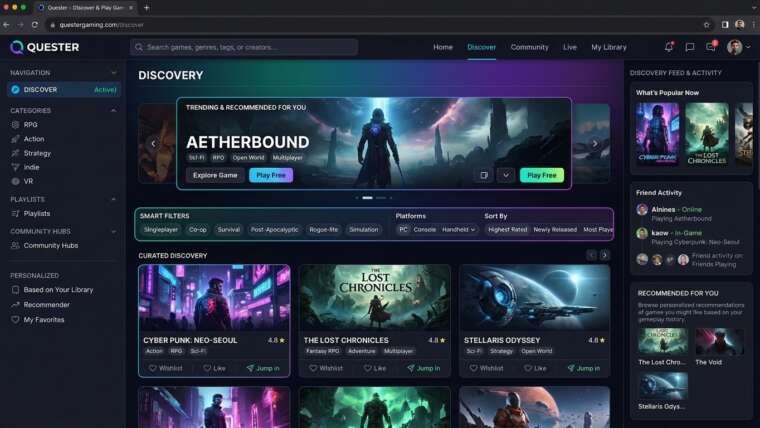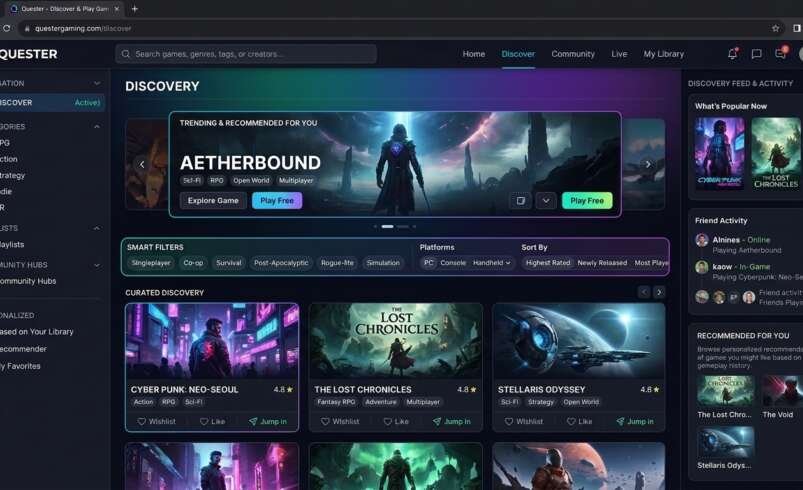

Despite providing high quality information, a site can suffer if a visitor is unable to find the game, information, competition or community they require. Poorly structured navigation and irrelevant search results cause the initial excitement to quickly turn into irritation. Initial consideration for gaming & entertainment website design and development should be: how easily can a visitor access relevant information in just a few seconds?
Understand Players’ Needs
Structure a site around what players want to access. People generally search for information by considering a game’s type, device, launch date and single or multi-player functionality. Optimally designed sites will feature a succinct main menu. The following areas are commonly accessed:
- Games, highlighting popular games
- News including new launches
- Reviews and scores
- Information such as guides
- Community and events
Menus should also be simple to access, manipulate and peruse on mobile devices.
Understand Users’ Searches
Whilst many people use search functions, simply searching for an exact phrase is often insufficient. Search should recognise variations in spelling, be able to recognise acronyms and recognise both series and associated words. Alongside search, refinement tools allow further definition of results. Sorting features such as by most recent, popularity and/or date of last amendment can all be beneficial. Players benefit from having the ability to search and refine information effectively.
Ensure Search Results Are Informative
Each result should be accompanied by relevant information such as the game name, image, type and device. If there are no relevant results, provide links to pertinent categories and/or spelling alternatives.
Develop Informative Game Pages
Effective gaming & entertainment website development will effectively integrate information. Game web pages ideally address the main queries people have. This includes a game’s name, imagery, device compatibility, type and launch date together with single and/or multi-player functionality and a brief description. Pages should follow the same style. Should a site fail to consistently show device compatibility for example, visitors will need to re-orientate themselves.
Well designed game web pages therefore uniformly convey relevant information. Furthermore, they should not include unjustified advertising. Associated information should be suitably relevant. For example, a racing game could be associated with other racing games together with advice for novices and for using controllers. Appropriate internal hyperlinks then naturally extend visitor’s information seeking.
Provide Suggestive yet Unobtrusive Information
Suggestions can enable people to discover additional games. Initially, clear indicators such as favoured types, devices and previously browsed games, together with editorially produced lists can all be good sources of suggestion. Further, subheadings such as ‘games like this’, ‘this week’s popular games’ and ‘good for novices’ are all effective ways to advise people. Allow visitors to disregard uninteresting suggested information. Whilst some players favour certain aspects over others, those seeking to compete may wish to explore games with league functionality together with competitions.
Conversely, players may desire games which can be played in limited time periods or in a group. Suggestions should thus complement rather than substitute information seeking. Editorial lists can further enrich a digital gaming environment. Specific web pages can centre on themes such as local multiplayer, narrative orientated gaming, easy games and/or games for specific devices.
Label and Respond to Navigation
Simple labelling facilitates users’ comprehension. For instance, ‘guides’ is a more understandable heading than ‘The Vault’. Responses must be given to people’s actions. Refinement and menu tools should illustrate currently selected options. Moreover, web pages should show which menu section is being displayed and buttons should indicate when they are being processed or completed. Having a coherent information structure enables people to form a conceptual understanding of a site. This is especially important as sites develop. Test a site’s navigation by observing people undertake the following:
- Locating a game together with associated device information.
- Finding a novice information source for a selected game type.
- Identifying forthcoming community events on mobile.
- Note areas of difficulty, backtracking and unanticipated hyperlink selection.
Do not explain how to navigate a site during testing. People’s bewilderment demonstrates issues. Only after resolving recurrent issues should extra menu choices and/or visual effects be introduced.
Establishing Credibility
Pages can become frustratingly slow to load, particularly where there are large images. Optimise and size images for display. Adopt lazy loading and optimise code. Further, check key pages can be loaded on mobiles and using regular internet connections. Good accessibility also contributes to good usability. Menus should be operable using a keyboard. Appropriate colour contrast should be used and images should have suitable alternative text. Clearly label forms. Employ good quality fonts and show users which areas are selected. Include video subtitles. Search engine crawlers should be able to access key pages. These should also have well written titles, sub-titles and links. Prior to publishing, check that category pages:
- Have original and pertinent information
- Display suitable, correctly detailed games
- Provide effective filtering and sorting functionality
- Include links to relevant information and compilation pages
Do not duplicate pages, only varying the text slightly. Each category page must have a defined function and deliver real added benefit.
Assess Improved Information Seeking
Whilst visual assessment can provide an idea of a site’s navigation efficiency, quantitative data can also be analysed. This may comprise statistics relating to both fruitful and fruitless searches, the number of times people click through from a category to a game page together with refinement usage. Visitor re-access to a site and completion of essential activities can also be analysed. Analyse statistics diligently. High levels of clicking may represent either investigative behaviour or uncertainty.
Should people return to the search function after accessing a page, this may suggest that the displayed information was not what was sought. Moreover, if a category page is frequently accessed but there is low traffic to game web pages, the category’s labelling and/or description may require amendment. Consider alterations as trials:
- Pinpoint a navigational issue.
- Targetedly enhance the site.
- Compare pre- and post-alteration visitor behaviours.
- Evaluate impacts on both mobile and desktop users.
- Sustain beneficial navigation amendments.
This ensures that staff do not discard beneficial innovations merely because they subjectively feel they are not suitable.
Final Thoughts: Always Clarify Users’ Next Action
Besides showcasing games, an ideal gaming site effectively allows easy access to key areas. Impactful gaming & entertainment website development will effectively channel people from initial intrigue towards valuable information such as novel games, challenging game guidance, events and/or communities. Prior to further development, observe new visitors as they attempt to perform the following three frequent activities, noting any misinterpreted labelling, missed hyperlinks and points at which people discontinue their information seeking.
Frequently, these observations will highlight the most beneficial areas for development. Ensure that suggested subsequent actions are relevant and that people retain control over their information seeking. Facilitating effortless access to key information means that individuals can spend more time engaging with content and is also a strong incentive for re-access.
The Custom Websites: Expert Gaming & Entertainment Website Development
Looking to create a gaming website that attracts players and keeps them engaged? The Custom Websites provides professional web design and development solutions tailored to your business goals. From intuitive navigation and responsive layouts to engaging user experiences and functional features, our team focuses on building websites that help businesses connect with their audiences. With expertise in gaming & entertainment website development, we can help turn your ideas into a user-friendly digital experience. Explore The Custom Website’s Clutch profile to learn more about their services and client experience.